Echidna
|
| posted on 2/3/08 at 06:48 PM |

|
|
Available space for inboard setup
Could someone measure the available space between the (Yamaha R1) engine cradle and the nose of the chassis, perhaps with some pics?
I am looking for this as i am going to design an inboard suspension setup and need to know if i can "squeeze" the rockers and dampers in
there.
I don't want to do the "conventional" and fit the dampers vertically because i don;t want to have my dampers heated by the
radiator.
Thanks in advance!
|
NOTE:This user is registered as a LocostBuilders trader and may offer commercial services to other users
|
|
|
colt_mivec
|
| posted on 2/3/08 at 07:04 PM |
|
|
Move the rad then or duct it so its always getting cold air
|
|
|
indykid
|
| posted on 2/3/08 at 09:33 PM |
|
|
you can't use normal oil filled coilovers horizintally like it sounds like you're planning.
you'll need something like nitrons which are horrendously expensive.
ducting air to the damper bodies in a conventional setup sound much more feasible, plus manipulating the spaceframe is much easier to accomodate the
loads in a vertical inboard setup.
tom
|
|
|
Echidna
|
| posted on 2/3/08 at 09:57 PM |
|
|
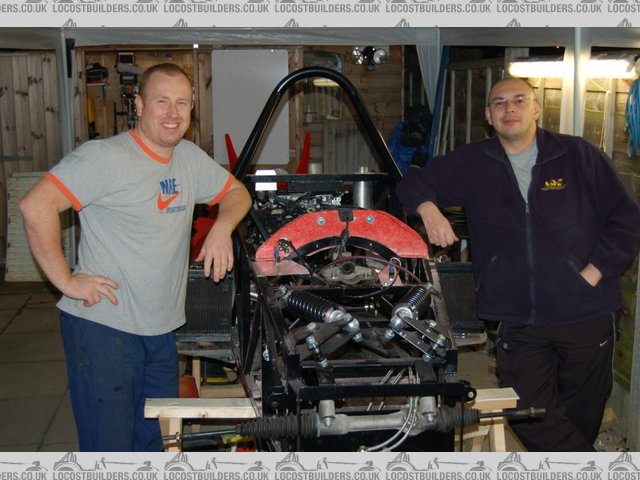
I am going for something like this setup.
There will be no problem if i use monotube dampers with a floating piston.
me and steve
|
NOTE:This user is registered as a LocostBuilders trader and may offer commercial services to other users
|
MikeCapon
|
| posted on 4/3/08 at 09:53 AM |
|
|
Shock absorbers
Looking at your initial question and the replies that follow may I offer the following advice.
1 Placing your shocks behind the radiator will not give you any problem due to "dampers being heated by the radiator".
Just look at the temperature of the air coming out of the back of the rad. Once the car is moving, the air will be heated very little. Probably in
single figures (°C). Try putting your hand behind a hot rad with the cooling fan on. You will see that it's not so hot! If anything, placing the
shocks behind the rad will tend to ensure that they operate at a more consistent temperature, making their performance more uniform with less
difference between "hot" and "cold".
There are plently of examples of shocks placed close to hot components with no performance disadvantage. Ducati's 916 springs to mind where the
rear monoshock is right next to the exhaust collector and all this is hidden from the airstream behind the motor. Didn't stop them winning I
don't know how many World Superbike Chamionships!
2 There seems to be a little confusion concerning the different principles of shocker. Strictly speaking there is no such thing as an "oil
filled coilover". If a shock was really full of oil it would be solid as it is imossible to compress the oil. The correct term is hydraulic,
simply meaning that the shock operates using a liquid, in this case oil. All shocks must have some means of allowing the rod to enter the shock body
as the shock closes. This is always a gas of some sort from air to other higher performance gases. All shocks work using oil, apart from the friction
dampers on very old vintage cars.
The type of shock that will only work in a vertical position, with the rod uppermost, is the cheapest type of damper possible where the shock is
filled to around 75% with oil, leaving a volume of air to compress as the rod enters. These are always twin tube shocks and the air lives between the
pressure tube and the body tube. Turn them on their side or upside down and the air gets where it shouldn't be, stopping the damping action.
A similar principle is the "emulsion" system. Instead of air, a gas, usually nitrogen, is introduced into the shock under pressure
(generally around 10 bar) and allowed to mix with the oil, hence the term emulsion. This type of shock is almost always a monotube (the shock body you
can see from the outside is the tube that the piston is going up and down in). These work to an extent, but the mixed gas always causes poor response
at the begining of each movement of the suspension.
The type of shock that seems to be the most popular on Locosts is a twin tube gas shock. Spax is the oldest established maker of this type of unit but
from looking at them I would suspect that Gaz and Protech are the same principle. In this type of unit the gas (usually Sulphur Hexaflouride) is
contained in a cell which is in turn immersed in the oil. This type of shock is a little more complex but has the advantage of keeping the oil
separate from the gas, hence no "emulsion" and no problem mounting horizontal, upside down etc. The gas in the cell is at atmospheric
pressure.
The remaining category is the high pressure gas monotube. Here the gas is generally nitrogen again at high (6-15bar) separated from the oil by either
a floating piston or a rubber membrane. Less complex versions have the floating piston in the shock body at the opposite end from the damper rod.
Flashier units will have a reservoir or canister with the floating piston or membrane inside. These are your Nitron, Penske, Ohlins type units.
Overkill for a Locost and possibly harsher due to the high gas pressure.
Sorry to have rambled on a bit but this isn't a simple subject. Hope this makes things clearer?
www.shock-factory.co.uk
|
|
|