

Hi how tight or slack should the balance bar be in the pedal tube it slides in think mine is to tight
Cheers Ali
It should be able to slide though it without too much resistance. Is yours sticking then?
Are you talking about the bearing that pushes in to the main tube of the pedal? If so it should be loose enough to get it in to place, but tight enough so it wont come out once its in! It doesnt need to move, in fact it needs to stay exactly where you leave it - in the centre of the tube!
The spherical bearing should not be at all tight in the tube, since it needs to be moved when you adjust the bias. If it's tight then get some
emery onto the inside of the tube to remove any imperfections.
The clevises on the balance bar should be wound up close to either end of the tube to limit the movement of the bias bar - this will ensure that you
can still operate one master cylinder in the event of one of the circuits failing (but with more pedal movement required).
quote:
Originally posted by loggyboy
Are you talking about the bearing that pushes in to the main tube of the pedal? If so it should be loose enough to get it in to place, but tight enough so it wont come out once its in! It doesnt need to move, in fact it needs to stay exactly where you leave it - in the centre of the tube!
The clevises on the balance bar should not be wound up too close to either end of the tube that there is zero clearance, the trick is
leaving just enough clearance for the balance bar to work but still allow the bar to lock up when a total failure of one circuit occurs.
[Edited on 24/12/11 by britishtrident]
Explanation here
quote:
Originally posted by britishtrident
The clevises on the balance bar should not be wound up too close
The spherical bearing should slide from end to end easily, but not sloppily.
I bought an adjustable reamer from the mob in Devon, Tracey Tools, many years ago, just for that specific task.
Cheers,
Nev.
I always assumed the spherical bearing was fixed and the biad adj' was acheived by the movement left and right of each clevis. What holds the
clevis's in place if the bearing is supposed to move?
Maybe it depends on the bar, but my striker supplied (raldes) one doesnt have large plates at the end to stop it moving;
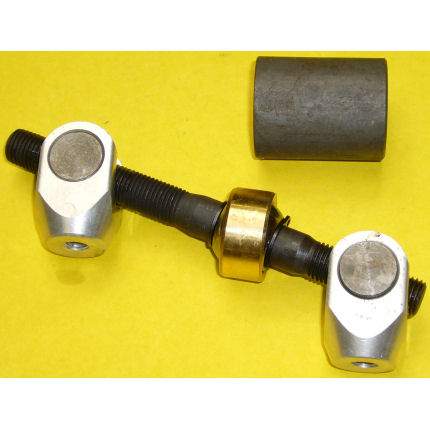
[Edited on 24/12/11 by loggyboy]
Indeed, it seems there are too types:
http://www.apracing.com/drawings/Balance%20Bar%20Systems.pdf
The wilwood setups have a moving spherical bearing, but the raldes basic one the clevis move and the bearing is fixed.
quote:
Originally posted by loggyboy
Indeed, it seems there are too types:
http://www.apracing.com/drawings/Balance%20Bar%20Systems.pdf
The wilwood setups have a moving spherical bearing, but the raldes basic one the clevis move and the bearing is fixed.
quote:
Originally posted by Neville Jones
ahh, not quite right.
That RD item above functions in exactly the same way as an AP item. When you assemble the setup in car, you need to put a large washer either side of the tube through the pedal, so that the clevis' have approx 1~1.5mm, or more, clearance either side.
The tube supplied by RD often is not of the correct diameter internally, hence the need for a reamer to bring out the ID so that the spherical WILL move side to side. Sometimes the tube will also shrink when welded. The pushrods of the master cyls should be pushing straight down the bore centreline, and not at an angle as would be if the clevis' were moved side to side. The clevis' should be assembled on the shaft so that they are on the same centreline separation as the masters.
This way, the spherical moves side to side within the tube. If anyone has the RD system fitted so that the clevis' move instead of the spherical, then it should corrected and fitted properly.
Read what I said above, and before that. Buy a reamer, or send the pedal back to the maker for correction if the spherical doesn't move freely
side to side, it's as simple as that.
The big washers stop the clevis' from twisting and jamming in the tube. I though that would be obvious?
Cheers,
Nev.