[img]
 [/img]
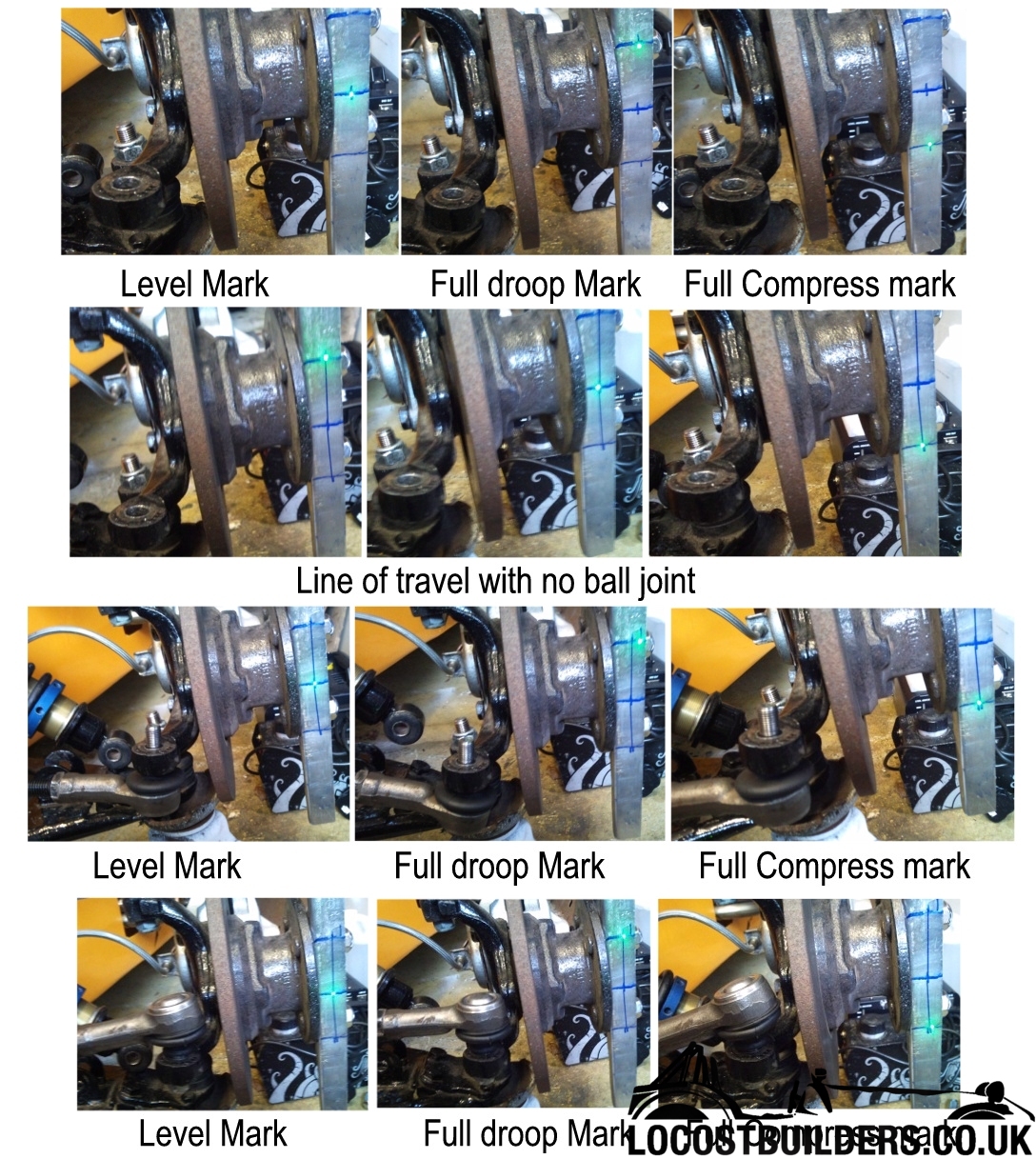
This morning I measured bump steer - fitting track rod end from top gives best result.
[img][/img]
Shining the laser into the hub (or bit of metal mounted to hub) is not a very sensitive way of measuring bump steer; a significant amount of bump steer will only move the dot a little bit. Better to clamp the laser pointer onto the hub and project it onto a wall, which will greatly improve the sensitivity (the further from the wall, the more sensitive it will become).
Mike is right - but either way that's a useful bit of work.
I would tend to favour reducing bump steer in the compression phase of the suspension movement and not worry quite so much on the extension phase. It
looks like you've found a good compromise with your final choice of ball joint on top.
Question; can you fit the ball joint from top OR bottom?
I thought they fitted with a taper and therefore only fit from one direction 
Oooops double post 
[Edited on 23/2/12 by JAG]
Surely there's the slop you get without a nut on the ball joint will make this inaccurate? Were these measurements very repeatable?
Track rod was tapped with a hammer nice and tight and had a nut on tight when i did it the other way round - was at this all morning.
Only photgraphed them after 50 tests or so with same results!!!
I will go with the laser on the hub/wall at some point as well just to be sure..
When i drove the car over bumpy road and got up to 50 it went mental and all over the place..
Also if you bounced the suspension the wheels toed out dramaticaly .. couldnt set an acurate track either.
I only put the ball joint on top out of curiosity - was amazed at the diffence.
Now bouncing the suspension i cant see any toe in or out and seems a massive improvement..
Not driven it yet but realy hope this will be a vast improvement..
cheers all  thank god the weather is getting better!!