sdh2903
|
| posted on 5/4/12 at 05:13 PM |

|
|
coilover spring question
When installing coilovers does it matter how far up/down the spring sits with regards to the threads on the body of the shock? Other than for
adjustment purposes. Ideally should the adjuster nut be halfway up the threads?
I ask as Ive fitted new slightly wider track front wishbones and am just getting everything bolted up, Ive never really paid attention to where the
spring sits before as they've only been trial fitted before.
cheers
Steve
|
|
|
|
|
mark chandler
|
| posted on 5/4/12 at 05:34 PM |
|
|
For me when on full droop the spring not to fall out, 1/2 way up in my case.
Regards Mark
|
|
|
spiderman
|
| posted on 5/4/12 at 05:34 PM |
|
|
They are for adjusting the ride height, the further up the thread the higher the height of your car giving you the most ground clearance and vice a
versa. Start in the middle and once fully built up and at full weight you can adjust either way to get the ride height you want.
Hope that helps.
Spider.
[Edited on 5/4/12 by spiderman]
Spider
|
|
|
owelly
|
| posted on 5/4/12 at 05:46 PM |
|
|
Not for adjusting pre-load then?
http://www.ppcmag.co.uk
|
|
|
bigfoot4616
|
| posted on 5/4/12 at 06:23 PM |
|
|
the ones you can adjust pre-load on also have another adjuster for the ride height.
|
|
|
spiderman
|
 posted on 5/4/12 at 06:24 PM posted on 5/4/12 at 06:24 PM |
|
|
quote:
Originally posted by owelly
Not for adjusting pre-load then?
Well I guess so, but I think both things apply unless someone can tell me different. I am not infallible and will always listen to anyone who has more
experience/knowledge.
Can you pre load the suspension without raising the height on our cars?
The more I learn, the less I think I know. & every day is a school day, are two sayings I like to live by.
Spider
|
|
|
bigfoot4616
|
| posted on 5/4/12 at 06:35 PM |
|
|
never seen anything like this for a kit car
http://www.jdmgarageuk.com/hsd-hr-coilovers
|
|
|
sdh2903
|
| posted on 5/4/12 at 08:44 PM |
|
|
The shocks I have are the standard protech ones, will have a play around with the upper mount to get the spring sat in the
middle.
Cheers for the input
|
|
|
FazerBob
|
| posted on 5/4/12 at 10:15 PM |
|
|
quote:
Originally posted by spiderman
quote:
Originally posted by owelly
Not for adjusting pre-load then?
Well I guess so, but I think both things apply unless someone can tell me different. I am not infallible and will always listen to anyone who has more
experience/knowledge.
Can you pre load the suspension without raising the height on our cars?
The more I learn, the less I think I know. & every day is a school day, are two sayings I like to live by.
The adjuster rings and threads on the body are for setting ride height only. It's a common misconception that they affect pre-load etc.
|
|
|
MikeCapon
|
| posted on 6/4/12 at 09:13 AM |
|
|
Morning all,
There are a lot of misunderstandings around shocks and suspension simply due to the jargon not being understood.
Here are some definitions which will, I hope, help:
Preload
Preload is simply the amount by which the spring is compresssed when fitted to the shock with the shock fully open. Lets say you have a 9"
spring. 228mm. If you measure the sping when it is fitted to the shock (with the shock fully open) and it measures 210mm you have 18mm of preload.
Preload is adjusted with the threaded spring seat seen below. More preload = raised ride height.
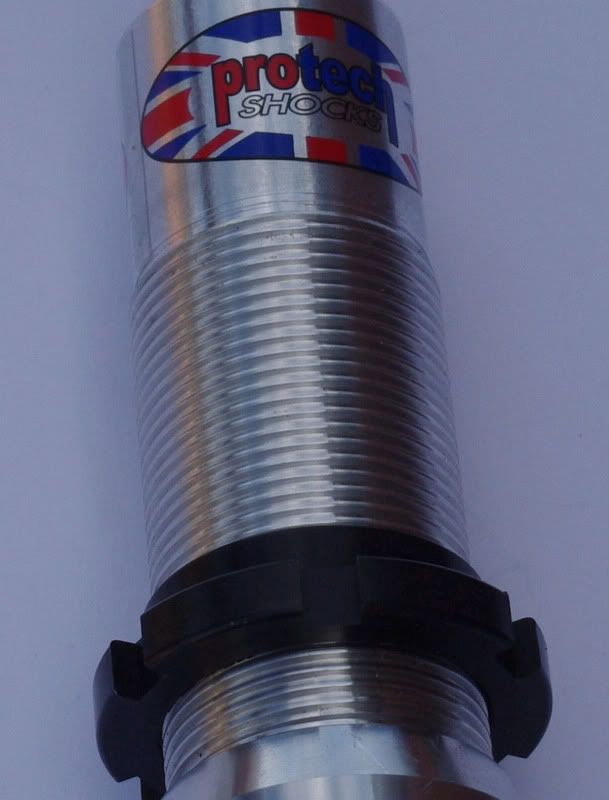
Ride height adjuster
A ride height adjuster is a means of changing the actual length of the shock. Usually a threaded end fixing with a lock nut
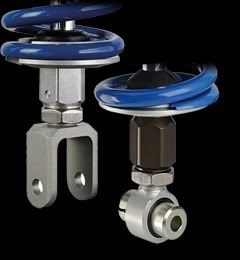
Both the preload and the ride height adjuster will alter the ride height. The difference between the two is as follows:
When a car is sitting at its static ride height (usually considered to be in its loaded condition) the shock will be neither fully open or fully
closed.
Part of the movement (stroke at the shock or wheel movement at the wheel) will remain available so that the shock can close or compress to follow a
bump on the road surface, a roll in cornering (outside wheel) or front dive under braking. This remaining movement is referred to as bump.
Equally part of the movement will remain available to allow the wheel to descend/the chassis to lift, to follow a dip in the road surface, roll in
cornering (inside wheel) or lift of the rear shocks under braking. This movement is referred to as droop. (Sag on a motorcycle)
On a Seven type car the typical bump and droop values will be around 60% of the movement in compression and 40% in droop.
Increasing the spring preload will increase the available bump movement and reduce the available droop movement.
Using a ride height adjuster will only increase the ride height. The bump and droop values will remain unchanged.
I hope this helps. If it is not clear please tell me and I'll do my best.
To go back to the OP. The starting point for the preload is not a big deal. Bolt the shocks on the car with the spring seat in a postion that just
starts compressing the spring (shock fully open). Lower the car to the floor, roll back and forwards about half a wheel turn and check the ride
height. It will almost certainly be too low. Turn the spring seats until you get the ride height desired. Roll back and forwards each time before
measuring.
Cheers,
Mike
|
|
|
phelpsa
|
| posted on 6/4/12 at 09:20 AM |
|
|
Preload only occurs if running zero droop (droop limited) suspension.
|
|
|
MikeCapon
|
| posted on 8/4/12 at 06:22 AM |
|
|
quote:
Originally posted by phelpsa
Preload only occurs if running zero droop (droop limited) suspension.
Could you please define:
Preload
Zero Droop Suspension
Droop Limited Suspension
Some links would be good too.
Thanks,
Mike
|
|
|
phelpsa
|
| posted on 8/4/12 at 07:51 AM |
|
|
quote:
Originally posted by MikeCapon
quote:
Originally posted by phelpsa
Preload only occurs if running zero droop (droop limited) suspension.
Could you please define:
Preload
Zero Droop Suspension
Droop Limited Suspension
Some links would be good too.
Thanks,
Mike
Preload in terms if vehicle suspension is when the spring is loaded by the spring seat to a greater extent than the load that the vehicle's
weight places on it.
This is demonstrated by placing the car on the floor, then winding the spring seats up until the suspension is in full droop. If the spring seat is
wound up further then it is becoming preloaded.
This means that you now have no droop travel which is known as zero droop, which is a form of what is sometimes known as droop limited suspension.
Droop limited suspension: when you have less than the designed amount of droop, often used to reduce grip at the front end during corner exit on RWD
cars, or reduce grip at the rear on corner entry on FWD car.
|
|
|