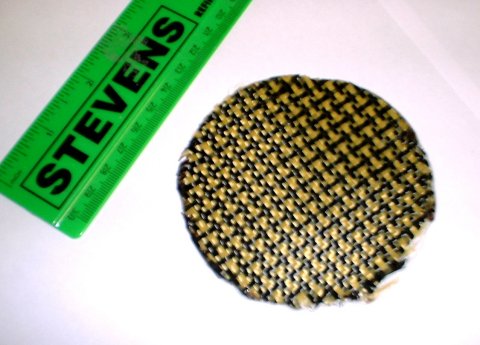
carbon/kevlar thickness
blakep82 - 6/12/07 at 07:59 PM
I'm thinking (subject to price  ) of making a diffuser for the back of the truck. nothing too extreme, just something to fill the space under
the back panel (under where it says connecting people on the one underneath)
) of making a diffuser for the back of the truck. nothing too extreme, just something to fill the space under
the back panel (under where it says connecting people on the one underneath)
how thick should the diffuser be? ie, how many layers of carbon/kevlar fabric would it take?

nick205 - 6/12/07 at 08:22 PM
No idea, but I do like the look of that pick-up 
phelpsa - 6/12/07 at 08:35 PM
There's so many variables it's difficult to tell! What type of carbon fibre do you plan to use? How/where will it be mounted? How effective
do you want it to be? What shape will it be? Will there be any reinforcements?
Having done some work experience in a carbon shop (and hoping to go back again!) I now understand how complicated carbon fibre is to work with and use
effectively. Half the kit you see that's made out of carbon fibre has no real advantage over fibreglass/plastic as it hasn't been used
effectively to take advantage of the extra strength of carbon.
britishtrident - 6/12/07 at 08:41 PM
Real Carbon fibre is very brittle it really isn't much good on it own, it especially dosen't take minor impacts from stones and the like,
Kevlar is tougher but for this application you want woven glass cloth.
[Edited on 6/12/07 by britishtrident]
blakep82 - 6/12/07 at 09:22 PM
this shape basically-

as for effectiveness, doesn't have to be really, the idea is to fill in that space under the rear panel with something that looks nice (thats why
i was thinking carbon/kevlar weave) mounting would be bolted around the back panel and where the bottom of the back wings bolt to the chassis (just in
front of the back wheels). reinforcements, don't know really...
obviously needs a lot more thought, but if i was needing say 5 layers, it'll cost far too much and not be worthwhile 
BT, thats interesting, i'd always assumed carbon would be stronger than fibreglass, but yeah, its harder (which isn't stronger!) If i WAS to
do it, i guess i could laminate 1 layer of carbon/kevlar as an outer layer, and another 4 layers of glass cloth?
twybrow - 7/12/07 at 12:00 AM
Chaps - let me clear up a few things for you. Firstly 'carbon' is available in so many forms, from basic tows (lots of individual carbon
filaments grouped into a bundle of say 12,000 - hence 12k, or 3k, 6k, 24k etc). These tows can then be woven or stitched to form fabrics/cloths.
Again, many different types, weave styles, coatings etc. This cloth could have an areal weight (weight per unit area) from as little as 50g/m2 upto
well over 1000g/m2.
Now then, a designer would need to know a lot of factors to enabe him/her to design effectively with carbon reinforced plastics (CFRP) or any other
exotic fibres such as Kevlar etc (be aware, Kevlar is great for impact resistance, but also absorbs water very readily - this can lead to premature
delamination.
As a rough estimate for thickness, you would need to know the areal weight of the fabric(s) you are using, then as an estimate, if the weight is say
330g/m2 (a fairly standard aerospace weight), the thickness will be approx 0.33mm per layer. As such, for a 1.5mm thick structure you would need 5
layers. This is very rough and will depend a lot on the technique you use to manufacture.
Personally, I would do a glass and carbon mix - something like this:
glass
carbon
carbon
glass
====== centreline
glass
carbon
carbon
glass
Sorry if this is too much (or not enough) - I just dont want you to have a nasty shock when costing this up, as it wont be cheap!
[Edited on 7/12/07 by twybrow]
blakep82 - 7/12/07 at 12:39 AM
 its gonna need a lot of layers then! hmm, guess that ideas out then ,on cost better things to be spending money on. like an engine...
maybe i'll leave that for small dress items then 
Thanks everyone though
[Edited on 7/12/07 by blakep82]
Ivan - 7/12/07 at 05:47 AM
Wouldn't it be simpler and maybe not much heavier and most probably a lot cheaper to make one out of aluminium
Syd Bridge - 7/12/07 at 11:01 AM
All experts, and all sprouting misinformation.
For starters, glass is heavy and more brittle in laminate than carbon and kevlar. This is taken from practical field tests and the test rooms of a
well known aircraft part manufacturer not a mile from where I sit. Also quite common knowledge to engineering designers who work in composites.
The resins have as much to do with strengths as the fibres. No use having a good strong fibre, then using a brittle resin that cracks then fails the
fibre. The resin and fibres have to be matched for properties, then against the application.
As to the diffuser....
The thing is probably unstressed (relatively), so a single layer of 200gsm plain weave carbon either side of 3mm core would be more than ample. If you
want it a bit more robust, double the carbon and make the core 5mm. Both of those specs can be found on serious racecars everywhere. Which one depends
on speed and size.
Anything more than this is a waste of good material and your time. The weakest carbon is still near to three times the tensile strength of steel,
just to put things into perspective. The resins are something else entirely.
Carbon needs to be used with epoxy or phenolic to be useful. Poly resin just don't make it!
Just think if you made the diffuser out of mild steel. How much steel would you put either side of a 3mm ply core? Now put a 5mm core in there, and
think how much stiffer it is.
It is very easy to make some test samples up with steel sheet and ply, and is a method I use to illustrate when teaching engineers.
I could go on, but doubt it would be of use to those of you who are much more knowledgeable than I. After 35 years of working with carbon, I am
constantly finding new applications with new resins.
The new batch of metal and polymer fibres are even more challenging. All good fun! 
Cheers,
Syd.
twybrow - 7/12/07 at 11:42 AM
Syd - I suggest you respond to all composite related posts from now on and the rest of us will just keep quiet, because clearly, no one else has a
valid point of view.
DarrenW - 7/12/07 at 02:04 PM
2nd vote for ali - sounds like a more diy friendly route, at least for prototyping at first.
phelpsa - 7/12/07 at 02:20 PM
*agrees with Syd*
Get some core in there and you really won't need much carbon to the the strength you need if it isn't going to creating any downforce. I had
a got at destroying a piece of 3mm core with a layer of 400gsm each side and there was no chance, even with weapons :p
Also i wouldn't start dealing with kevlar. As far as i can tell (Syd will be able to go into more detail) you have to be much more careful with
it and how it's laid.
twybrow - 7/12/07 at 03:27 PM
Adding a core would increase stiffness, not strength - but I agree, in an ideal world, with a full shop of equipment and experience, it would be the
route to go down. However, in your garage, by hand, it is not a good DIY route. Plus, most foam cores are pretty damned expensive (up to £200/m2!).
I already mentioned the issues with Kevlar - moisture uptake and fraying of the fibre due to damage, not to mention the problem with cutting the stuff
- again, not a good DIY route.
jono_misfit - 7/12/07 at 03:54 PM
If your using epoxy resin couldnt you use some expanded polystyrene as the core material.
Its not a structural part so strength isnt really an issue but a bit of stiffness doesnt go amiss.
You could also use expanded cardboard for a true "locost" approach.
[Edited on 7/12/07 by jono_misfit]
twybrow - 7/12/07 at 04:05 PM
Yeah you could - not sure how well it would adhere long term, but if you had some resin, you could give it a go and see. It would be a complex shape
to try to hand lay with core with no mould. You could make it as a series of flat panels then bond them together...
Syd Bridge - 7/12/07 at 07:05 PM
quote:
Originally posted by twybrow
Syd - I suggest you respond to all composite related posts from now on and the rest of us will just keep quiet, because clearly, no one else has a
valid point of view.
Every one has a valid point of view. It hasn't got to be correct though.
Then there's a couple who sprout complete bullshite, because they don't fully understand what they've read elsewhere on the 'net,
before they repeat it on here!
Cheers,
Syd.
Schrodinger - 7/12/07 at 07:43 PM
quote:
Originally posted by blakep82
BT, thats interesting, i'd always assumed carbon would be stronger than fibreglass, but yeah, its harder (which isn't stronger!) If i WAS to
do it, i guess i could laminate 1 layer of carbon/kevlar as an outer layer, and another 4 layers of glass cloth?
You are not getting Carbon fibre & Kevlar confused are you 'cause they are not the same thing.
You would only need an outer layer of carbon backed up with GRP.
blakep82 - 7/12/07 at 07:49 PM
i mean the mixed stuff