chrsgrain
|
| posted on 9/4/07 at 07:10 PM |

|
|
Metal shaping help needed!
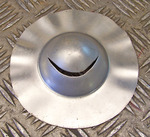
Hi all.... I'm hoping that someone can give me a few tips on how to form a shape from sheet ali. The pictures below show our first go, which
overall we're pretty happy with, but in forming the 'bulge' the bends in the sheet have distorted making the whole thing now not fit
(its to go at the end of the picture showing the underside of the boot - to cover the low pressure fuel hose)
Anyone got any tips about how to approach it? Have only got a sandbag and round ended lignum hammer as well as the usual workshop stuff.
All the pictures are clickable for a bigger look..


Thanks
Chris
Spoing! - the sound of an irony meter breaking...
|
|
|
|
|
blakep82
|
| posted on 9/4/07 at 07:41 PM |
|
|
hmmm, interesting.
not sure if there is an easy way to do that, I'm sure it can be done, but not sure how.
what about bending the sheet in the shape you want, but with a rectangular slot cut down where the bulge is to be, and then bending an ali channel to
be welded or riveted in place?
maybe a bit more cutting and shaping, but maybe a neater result?
________________________
IVA manual link http://www.businesslink.gov.uk/bdotg/action/detail?type=RESOURCES&itemId=1081997083
don't write OT on a new thread title, you're creating the topic, everything you write is very much ON topic!
|
|
|
mark chandler
|
| posted on 9/4/07 at 08:32 PM |
|
|
Sorry chap, it will be hard graft with just those tools, you really need an english wheel.
But try annealing the metal to soften and use a slapper (broad wacker, people tend to male them out of old files by grinding the surface smooth) on
the proud side against a dolly to flatten the high spots.
Regards Mark
|
|
|
907
|
| posted on 9/4/07 at 08:34 PM |
|
|
Hi Chris
Without proper tools I think I would make that from pipe cut in half length ways
and use ends cut from a 90deg bend, then weld the sections together.
To beat it from sheet I would make two shaped thick flanges.
Cut the ally over size and bolt together like a sandwich.
Beat the shape through the holes in the flanges, then cut off the excess.
You will have more control if you use the ball hammer as a drift and hit it with another hammer.
That's a hard thing to make by hand. That's a good first try.
Paul G
|
|
|
omega 24 v6
|
| posted on 9/4/07 at 09:58 PM |
|
|
quote:
You will have more control if you use the ball hammer as a drift and hit it with another hammer.
If your gonna do this make sure you use a soft face mallet as ball pien hammers have hardened faces and should not be struck toether EVER. First year
apprentices where I seved my time would have had a warning for doing this.
If it looks wrong it probably is wrong.
|
|
|
907
|
| posted on 9/4/07 at 10:14 PM |
|
|
Absolutely Omega, but Chris said it was a lignum hammer.
AFAIK that's a very hard wood.
As my old college tutor told us many years ago....
"Hammers are made from mayonnaise steel. Mayonnaise steel work hardens to martensite"
 Never forgot that. Never forgot that.
Thanks for pointing it out though. It could save someone an injury.
atb
Paul G
p.s. That was Don Riddle's way of making us remember manganese steel.
[Edited on 9/4/07 by 907]
|
|
|
John Bonnett
|
| posted on 10/4/07 at 07:13 AM |
|
|
Hi Chris
Wherever possible, I resort to the old trusty Hammerform just as 907 suggests. I made the bulge for the bonnet using this technique and you should be
able to achieve it without the need of a wheeling machine. There are one or two picture in my archive and I have covered the technique in my website.
When you get to the smoothing stage you can planish using a metal dolly(which has a similar radius of curvature to the bulge) held underneath whilst
giving glancing blows immediately above with a planishing hammer.
Do U2U me if I can give you anymore help.
Cheers
John.jpg)
|
|
|
omega 24 v6
|
| posted on 10/4/07 at 08:20 AM |
|
|
quote:
"Hammers are made from mayonnaise steel. Mayonnaise steel work hardens to martensite"
He He it's funny how the old tutors kept thing in our heads. But it worked. Now you've made me feel old with austenite and perlite and
martensite. Twas 28 years ago
If it looks wrong it probably is wrong.
|
|
|
gottabedone
|
| posted on 10/4/07 at 10:10 AM |
|
|
Hey Chris,
That is a commendable first attempt.
It's a very hard shape that you are trying to form and people would approach this with a dozen different ways.
I would make a 3d former out of a relatively hard wood. Make it in 2 halves the shape/contour that you require. Cut the lozenge shape that you
require out of both parts of the former and put a radius on the inside of the bottom half. Drill holes in top and bottom halves of the former, bend
your ali to the required shape and bolt inside your former. Your ali will then be clamped inside the former. This will help to stop it moving while
you form your shape and help to prevent distortion.
Access for tools inside this former may be a problem so you may have to break some of the rules already mentioned. I would form the shape with a
wooden pear shaped mallet, with the nose linished to a wide beak shape and nicely rounded.
If your panel comes out of the former distorted, you can work the metal with a flat hammer and flat metal surface underneath. Be careful that you
don't mark the edge of your ally when doing this.
have fun
regards
Steve
|
|
|