Lawnmower
|
| posted on 18/4/06 at 08:25 PM |

|
|
Aerodynamics of wet weather gear? (poll)
What goes quicker?
a car with full side screens roof,wind blocker etc?
or nothing?
or somehere in between?
remember more kit = more weight....
more kit = more drag?
|
|
|
|
|
tom_loughlin
|
| posted on 18/4/06 at 08:36 PM |
|
|
aaarrrggghhh my dissertation coming back to haunt me.....
Tom
|
|
|
k33ts
|
| posted on 18/4/06 at 09:09 PM |
|
|
itll be more aerodynamic if you took the spare wheel off the bonnet
tukcustoms.com
|
|
|
Krismc
|
| posted on 18/4/06 at 09:13 PM |
|
|
quote:
itll be more aerodynamic if you took the spare wheel off the bonnet
i agree and mybees Remove the front and back window too!
Built, Ivaed, Drove and now Sold - 2011 MNR VORTX RT+ 2000cc Zetec on R1 Throttle boddies.
|
|
|
Lawnmower
|
| posted on 18/4/06 at 09:20 PM |
|
|
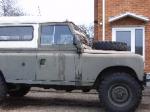
might be a bit nippy, us landy drivers need to keep as much heat as possible, think i get more heat through the transmission tunnel than the heater!
|
|
|
omega0684
|
| posted on 19/4/06 at 01:34 AM |
|
|
you would definately get a better 0-60, if you cleaned all that crap of the landy too
I love Pinto's, even if i did get mine from P&O!
|
|
|
Guinness
|
| posted on 19/4/06 at 06:47 AM |
|
|
"Aerodynamics are for people who can't build engines". -- Enzo Ferrari
I wouldn't worry about weather gear, or lack of it, it's the nut behind the wheel that controls the speed
Mike
|
|
|
cossey
|
| posted on 19/4/06 at 05:16 PM |
|
|
side screens hood etc might actually improve the aerodynamics of a screened car because it prevents the turbulence behind the screen from getting as
large. most convertables work this way with the roof up.
|
|
|
Krismc
|
| posted on 19/4/06 at 07:47 PM |
|
|
Screen, he he if only one was available
Built, Ivaed, Drove and now Sold - 2011 MNR VORTX RT+ 2000cc Zetec on R1 Throttle boddies.
|
|
|
David Jenkins
|
| posted on 19/4/06 at 08:09 PM |
|
|
quote:
Originally posted by cossey
side screens hood etc might actually improve the aerodynamics of a screened car because it prevents the turbulence behind the screen from getting as
large. most convertables work this way with the roof up.
Screen? Who has a screen?
David
|
|
|
Rob Palin
|
| posted on 20/4/06 at 07:54 AM |
|
|
For a standard 7 the difference between roof up & side windows and a fully open set-up is 16%. Assuming everything else being equal and gear
ratios optimised etc etc, that should be worth about 8% on top speed. Worth doing then.
"Aerodynamics are for people who can't build engines". -- Enzo Ferrari
Interesting that Ferrari now put huge emphasis on aerodynamics, both for road and race cars. I guess the Old Man would be spinning in his grave,
though perhaps not as rapidly as if he'd sorted his aero out... 
|
|
|
ned
|
| posted on 20/4/06 at 08:14 AM |
|
|
I can't believe the results of this poll it just shatters my logic completely!
having a screen and weather gear is of course going to add to air resistance etc and doing without them is going to make the car have a lower frontal
area to push through the air. The next point in my mind is drag.
Those who have selected the 'nothing' option obviously haven't thought about this. full doors are obviously no good (or can't
be fitted) without a screen but half doors and/or a tonneau cover across the passenger seat are going to smooth the airflow over the cabin and
severely reduce the turbulence and hence the drag coefficients for the car.
I don't mean to sound arrogant but to me it seems like such a no brainer.
dons tin hat and ducks for cover (quack)
ps i recall someone posted a model of a 7 with air flows over the car, possibly a uni dissertation or something- who was that?
[Edited on 20/4/06 by ned]
beware, I've got yellow skin
|
|
|
Rob Palin
|
| posted on 20/4/06 at 08:59 AM |
|
|
Ned's right. Switching from a full screen to an aeroscreen will reduce the drag force acting on the car.
However, it doesn't actually change the drag coefficient very much. The CD is a 'shape factor' and takes several things into
account, including the frontal area. With the full screen the actual drag force acting on the car goes up but then so does the frontal area and, in
this case, by almost the perfect amount to leave the drag coefficient the same, at around 0.61.
Fundamentally the 7 is just the wrong shape; the widest/tallest part of the car is right at the back. Anyone seen many aerofoils or teardrops shaped
that way? Nuh-huh. 
|
|
|
cossey
|
| posted on 20/4/06 at 10:23 AM |
|
|
my point was if youve got a screen then the roof etc will probably reduce drag over no roof but with a screen. no screen is obviouly better for 2
reasons 1 less frontal area and 2 lower Cd due to the very unaerodynamic flat screen.
Cd or drag coefficient does not change with frontal area (thats the whole point of it) the idea is that a scale model that is geometrically the same
but a different size will have the same Cd but a different frontal area, this is why Cd is usefull for model testing in wind tunnels.
a screened 7 has a Cd of about 0.65 which is about 2x that of a normal car an un screened one is just over 0.61 iirc. something like a fury/phoenix
etc will have a Cd of about 0.3 with a screen and about 0.26-0.27 with out (less difference as the screen is curved) but they have a very similar
frontal area to a 7 so have massively less drag, hence a phoenix gaining 10-15mph more speed at the end of a long straight over an indentically
chassis striker.
|
|
|
Rob Palin
|
| posted on 20/4/06 at 11:09 AM |
|
|
I think the CD of the Fury/Pheonix is closer to 0.4 at best, and certainly nowhere near 0.26 in any configuration.
Only the Audi A2 and Toyota Prius dip below 0.27 and the best open-top car currently in production is the Merc SL which has a CD of 0.33 hood down.
To get below 0.3 you need to do a lot of work on planform shape and detail optimisation around the wheels & underfloor. It would have to be a
very special car to drop below 0.3 without a full cockpit cover of some sort.
|
|
|
cossey
|
| posted on 20/4/06 at 05:42 PM |
|
|
the fury/phoenix has a far more rounded front end with a much lower bonnet profile, a flat floor with no mechanical parts hanging down, comparatively
small front grill, and no shut lines.
0.4 is more than an old beetle or equivalent to an average suv/pick up. a tonneaued fury with the lemans bonnet and a smallish roll bar will be well
under 0.3
something like this but with a tonnaeu

|
|
|
Rob Palin
|
| posted on 20/4/06 at 08:49 PM |
|
|
Well, the front side corners are rounded but there's an extremely short overhang and they leave the front wheels very exposed - terribel for
both drag and lift.
The centre section of the bonnet has way too smalla radius for the flow to stay attached around it and so you'll get separation right at the
leading edge.
The cooling air has nowhere else to exit other than the underfloor or front wheelarches. If it is allowed out the underside then it will render an
otherwise flat floor redundant. If it exits through the front wheelarches then there would need to be a sizable radius on the back edge of the
wheelarch, blended into the side otherwise you will get an enlarged front wheel wake increasing the effective frontal area very significantly.
Shut lines make next to no difference to the drag of a vehicle unless they are in an area on the edge of separation already or if there is substantial
aspiration through the gap (like around a poorly-sealed bonnet).
Having an open cockpit with short rear body will mean that the flow cannot reattach before reaching the back of the car, making the effective base
area much bigger than the actual car geometry. This will be exaggerated by the flared rear wheelarches and the lack of useful boat-tailing at the
rear of the body.
Tonneau covers don't always make a fat lot of difference, especially if used in conjunction with a windscreen or air deflector of sorts. On my
Locost the cover made a difference of 0.008 to my CD of 0.61...
The CD of an old Beetle is actually comfortably in excess of 0.5. That sort of figure may still be reasonable for a poor pick-up truck but most SUVs
are now down between 0.38 and 0.45.
I don't mean to sound disrespectful but there is no chance in the world that the Pheonix has a CD less than 0.3. As part of my job i maintain a
database of the aerodynamic characteristics of (almost) every major production car which extends back to 1961. During that time no manufacturer has
made an open-top sports car with a CD below 0.3. 0.33 is the best i can find. Bearing in mind that some of those cars will have spent around 1000
hours in the wind tunnel during their development, i think it's quite unlikely that Sylva managed it with zero hours and despite having some
clear flaws in the design as mentioned above.
It is still a very pretty car, and a damn sight more slippery than a 7 but there is a fair bit of room for improvement.
|
|
|
tom_loughlin
|
| posted on 28/4/06 at 10:23 PM |
|
|
Just re-read this thread, and some of the numbers quoted for the Cd of this type of car are well off. Cd is a relationship between the forces
experienced on a body and the size of the frontal area - thats how the scaling factor comes into play.
i can say 100% that no se7en has been anywhere near Cd 0.5.
I could show pictures, but im starting to bore even myself now....
|
|
|
cossey
|
| posted on 29/4/06 at 07:03 AM |
|
|
quote:
Originally posted by tom_loughlin
Just re-read this thread, and some of the numbers quoted for the Cd of this type of car are well off. Cd is a relationship between the forces
experienced on a body and the size of the frontal area - thats how the scaling factor comes into play.
i can say 100% that no se7en has been anywhere near Cd 0.5.
I could show pictures, but im starting to bore even myself now....
caterham teted on of their 7s in a wind tunnel the result was 0.62 from memory. (it was definantly over 0.6)
drag coefficient is the ratio of the drag force to the dynamic pressure x area so it is a measure of how slippery a shape is which a screened 7 (ie
what was tested) definantly isnt.
|
|
|