davidinhull
|
| posted on 4/11/08 at 09:06 PM |

|
|
Will this end in tears
Hi
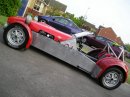
I want to put a pair of driving lights/fog light type things on the front of my striker, just want someone to tell me if I'm going to cause
myself a mischief
the two lights are a 50w bulb in each, I want to wire from ignition power through a 10amp fuse, a 16a rated switch (with LED) and 17amp wire as I have
these available. will this need a relay and if not will what I've suggested be OK?
Thanks
|
|
|
|
|
nitram38
|
| posted on 4/11/08 at 09:40 PM |
|
|
Approx running current is about 8.2 Amps, so no to a relay.

|
|
|
iank
|
| posted on 4/11/08 at 10:08 PM |
|
|
As ^^^ the 10A fuse being less than the wire/switch will protect them even if there is a short.
1.8A headroom should be plenty for a couple of bulbs.
Make sure the LED in the switch is rated for 12v or you have the appropriate resistor else it will blow.
--
Never argue with an idiot. They drag you down to their level, then beat you with experience.
Anonymous
|
|
|
02GF74
|
| posted on 5/11/08 at 08:31 AM |
|
|
Acouple of points. The above calculation works out the current assuming electrics are at 12 V; with a working alternator it is more like 14 V.
Current will increase accordingly.
What I have never found out is that although car bulbs are described as 12 V bulbs, is the wattage calculated for 12 or 14 V?
Also the current drawn thorugh a cold bulb is much higher than one the bulb's element has warmed up; you may find 10 A fuse not to be enough.
i.e. it will blow when you trun the lamps on.
Finally looking at VWP website, for headlamps they recommend 2 mm2 wire, 25 A rating.
I reckon you will be ok, although it may be marginal. If you have some spare 17 A wire, wire both bulb using about 1 m of it and and feel how hot it
gets. You could also measure current for 1 bulb and then reassess the situation.
[Edited on 5/11/08 by 02GF74]
[Edited on 6/11/08 by 02GF74]
|
|
|
davidinhull
|
| posted on 5/11/08 at 10:03 AM |
|
|
Thanks for the input,
since it seems I'm not doing anything too outragous I'll wire it up and see what happens
|
|
|
Vindi_andy
|
| posted on 5/11/08 at 12:21 PM |
|
|
I may be wrong but doesnt ohms law state that if the voltage goes up for equivalent power the current goes down because:
P=VI
|
|
|
nitram38
|
| posted on 5/11/08 at 04:38 PM |
|
|
02GF74, you made a slight mistake.
Resistance goes up with temperature so current goes down not up.
The colder something is the lower the resistance and therefore more current flows (remember superconductors?).
This means that as the lamp gets hotter the current will reduce, not increase.
|
|
|
Macbeast
|
| posted on 5/11/08 at 06:03 PM |
|
|
Vindi- You're assuming that a lamp rated at 50W will always dissipate 50W whatever the voltage applied to it.
In reality I = V/R so if the resistance is constant (which it won't be if you overload it but don't let's be picky  ) the current
in the lamp will be higher at 14V than at 12V. ) the current
in the lamp will be higher at 14V than at 12V.
|
|
|
02GF74
|
| posted on 6/11/08 at 08:34 AM |
|
|
quote:
Originally posted by nitram38
02GF74, you made a slight mistake.
Resistance goes up with temperature so current goes down not up.
Tis true for bulb filaments; I didn't proof read hard enough so allthough I knew what I meant, I didn't quite express it correctly.
Edited it now. 
|
|
|
Vindi_andy
|
| posted on 6/11/08 at 11:17 AM |
|
|
God damn are we all electronic guys on here
Its been a while since i did it but my apprenticeship was in electronics
|
|
|
davidinhull
|
| posted on 9/11/08 at 05:51 PM |
|
|
I now have fully functional lightsso it wasn't a disaster
|
|
|