That sidecar is nuts!!!
I'm liking the simplicity of the transverse leaf spring at the front though.



I've been trawling through stuff looking for more front suspension ideas for the trike and found the 'Hurst Floor Shifter Special'
designed by a guy called Smokey Yunick.
That sidecar is nuts!!!
I'm liking the simplicity of the transverse leaf spring at the front though.
Smokey yunick was a great innovator, google and you will find lots of tales of his sideways thinking, not all of it legal as far as the rules go 
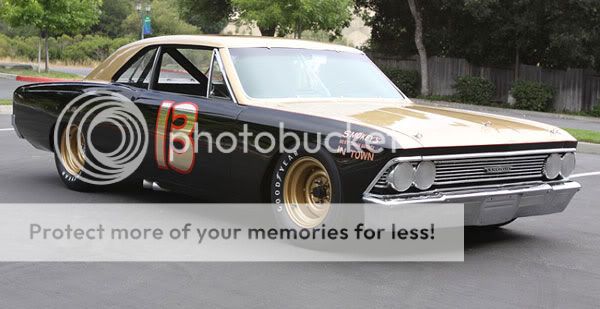
I hope all the stories are true, such as the Nascar he made 7/8ths size to cut frontal area and drag, only noticed when it was inadvertantly parked
next to a showroom model of the same car! 
words fail me in a I love it but I hate it sort of way
Although that squarish stearing wheel somehow makes me think of an austin allegro
Considering that it only ever has to turn left that's not all that bad
Smokey went further than Chapman with 'bending' the rules, some things were just illegal, but somebody has to do it, that's what's missing now!
Where do his legs go? That sidecar looks awfully short in the front.
http://en.wikipedia.org/wiki/Smokey_Yunick
quote:
Originally posted by CNHSS1
Smokey yunick was a great innovator, google and you will find lots of tales of his sideways thinking, not all of it legal as far as the rules go
I hope all the stories are true, such as the Nascar he made 7/8ths size to cut frontal area and drag, only noticed when it was inadvertantly parked next to a showroom model of the same car!
With a guy like that, he probably employed a driver with no legs!!! Cuts down on weight as well. Ho Ho.
 mmm
mmm

mmm
nobody noticed the intake trumpet sucking his right ear off ?
Scootz, thought you might like some info to go with the picture:
In 1930, a four-cylinder 151 cu in (2.47 l) Offy/ engine installed in a race car set a new international land speed record of 144.895 mph (233.186
km/h). Miller developed this engine into a twin overhead cam, four cylinder, four valve per cylinder 220 cu in (3.6 l) (3.6 L) racing engine. This
would be used in midgets and sprints into the 1960s, with a choice of carburetor or Hilborn fuel injection.
One of the keys to the Offenhauser engine's success was power. A 251.92 cubic inch (4,128.29 cm³) twin-cam four-cylinder racing Offy with a
15:1 compression ratio and a 4.28125-by-4.375-inch (108.744 × 111.1 mm) bore and stroke, could produce 420 hp (310 kW) at 6,600 rpm (1.77 hp per cubic
inch (81 kW/L). Other variants of the engine produced up to 3 hp per cubic inch (137 kW/L). Another reason for the engine's success was
reliability; unit construction (no separate cylinder head) meant the engine was not vulnerable to head gasket or cylinder stud problems and allowed
for higher cylinder pressures.
Before turbo boost limits, over 1,000 bhp (750 kW) could be attained using around 120 in Hg (44.3 psi (305 kPa)) boost. The final 2.65 litre 4 cyl
Offy, restricted to 80 in Hg (24.6 psi (170 kPa)) boost pressure, gave 770 bhp (570 kW) at 9,000 rpm.
The b-series of the 30's!
Offenhauser made this engine from the 1930s up to the 1980s. Even more amazing: It was based on a 1913 Peugeot race car engine!
quote:
Originally posted by Volvorsport
nobody noticed the intake trumpet sucking his right ear off ?
Can't believe the transverse leaf spring locates the uprights very well under hard braking, and I see no dampers (inboard on lower arms maybe?).
quote:
Originally posted by MikeRJ
Can't believe the transverse leaf spring locates the uprights very well under hard braking, and I see no dampers (inboard on lower arms maybe?).
quote:
Originally posted by MikeRJ
Can't believe the transverse leaf spring locates the uprights very well under hard braking, and I see no dampers (inboard on lower arms maybe?).
Saw it at this year's GWFoS - incredible, and fantastic in the flesh.