Hector.Brocklebank
|
| posted on 21/5/12 at 06:24 PM |

|
|
Fuel economy up by 50% !!!
Discuss.....
Fuel Economy Enhancement
Some people can never handle the truth and always try to shoot the messenger instead of taking an honest look in the mirror (its always easier to
blame another than to face reality), but secretly they wish they could grow a pair and be the messenger !!!
|
|
|
|
|
designer
|
| posted on 21/5/12 at 06:56 PM |
|
|
Apparently, the engine is a new 'concept', so what are they claiming the 50% improvement against?
|
|
|
blakep82
|
| posted on 21/5/12 at 07:01 PM |
|
|
quote:
Originally posted by designer
Apparently, the engine is a new 'concept', so what are they claiming the 50% improvement against?
quote:
According to MIT’s Technology Review, such an engine has the potential to increase the fuel economy of gasoline-powered cars by 50
percent
something of equivalent size/power i guess
as per usual the figures won't really match up, same with any marketing guff these days, however, since its delphi that are working on it, i
think its a bit more reliable than the usual hydrogen water electrolysis nonsense that usualy comes up.
i'm looking forward to laser 'spark' plugs being everywhere, not sure if there's much of a economy benefit, but i like
lasers...
________________________
IVA manual link http://www.businesslink.gov.uk/bdotg/action/detail?type=RESOURCES&itemId=1081997083
don't write OT on a new thread title, you're creating the topic, everything you write is very much ON topic!
|
|
|
Simon
|
| posted on 21/5/12 at 07:01 PM |
|
|
There has been talk of dieselling petrol engines for quite some time.
ATB
Simon
|
|
|
MikeRJ
|
| posted on 21/5/12 at 07:01 PM |
|
|
quote:
Originally posted by designer
Apparently, the engine is a new 'concept', so what are they claiming the 50% improvement against?
Over a conventional spark ignition engine.
|
|
|
mcerd1
|
| posted on 21/5/12 at 07:51 PM |
|
|
the claims arn't as impressive, but I recon this one looks like it has some real potential:
http://www.ilmor.co.uk/concept_5-stroke_1.php
-
|
|
|
Ninehigh
|
| posted on 21/5/12 at 08:03 PM |
|
|
Interesting.. would be good to see some kind of real world comparison too.
Also have that kind of engine powering an electric motor Ampera style...

|
|
|
JoelP
|
| posted on 21/5/12 at 08:27 PM |
|
|
dont believe it myself. I cant see how using a spark plug is so hugely inefficient compared to their system, considering that their engine sounds
basically the same as a normal engine. Audis FSI already does fancy stuff with the fuel delivery so its not like anything else about their system is
totally unique.
Not that IC engines arent hugely inefficient though, so im sure there is room to use more energy from the fuel. But this idea doesnt seem novel
enough. Maybe if they could make something like a fuel cell that reacted petrol at a catalytic surface, that would seem a new enough approach to make
huge improvements, but not some replacement for spark plugs.
|
|
|
mcerd1
|
| posted on 21/5/12 at 09:08 PM |
|
|
quote:
Originally posted by JoelP
dont believe it myself. I cant see how using a spark plug is so hugely inefficient compared to their system, considering that their engine sounds
basically the same as a normal engine. Audis FSI already does fancy stuff with the fuel delivery so its not like anything else about their system is
totally unique.
its all down to thermodynamics (not sure I beleve the 50% though) its main reason that diesel is more efficent than petrol
the Otto cycle that spark ignition engines are based on is inhernetly less efficent than comression ignition diesel cycle engines even in a perfect
world with no unwanted friction etc....
(I would go and open up my old thremodynamics books to get the details but they give me nightmares  ) )
[Edited on 21/5/2012 by mcerd1]
-
|
|
|
MikeRJ
|
| posted on 21/5/12 at 11:48 PM |
|
|
quote:
Originally posted by JoelP
dont believe it myself. I cant see how using a spark plug is so hugely inefficient compared to their system, considering that their engine sounds
basically the same as a normal engine. Audis FSI already does fancy stuff with the fuel delivery so its not like anything else about their system is
totally unique.
Compression ignition means you run very high compression ratios, like a conventional diesel engine. The thermal efficiency of a four stroke engine is
related to it's compression ratio, so the more the batter, but with spark ignition you are limited to a relatively low value by the fuel
octane.
FSi/GDi etc is a very small evolutionary step from port injection, and provides relatively small benefits (and quite a few of it's own
problems). A compression ignition petrol engine is a very different thing and is a significant step up in terms of benefits and technical
challenges.
[Edited on 21/5/12 by MikeRJ]
|
|
|
hughpinder
|
| posted on 22/5/12 at 07:17 AM |
|
|
I guess its possible that you could get "50% increase" in efficiency for a non turbo petrol engine. It has a maximum thermodynamic
efficiency of about 40%. An engine running the diesel cycle is about 50% thermodynamic efficiency, so 40% to 50% is a "25% increase". If
you add in heat recovery like in the elsbett engine (oil cooled with no radiator - If you remember many years ago top gear drove a merc running on veg
oil that had one of these engine and did about 60mpg while giving better power and torque). I suspect if you combined both of these you could get to
60% thermodynamic efficiency. I thought the main problem with running a diesel cycle with petrol was pre-ignition of the fuel (pinking), and I wonder
what they've done to overcome it.
Hugh
|
|
|
coyoteboy
|
| posted on 22/5/12 at 12:31 PM |
|
|
You'd be lucky to see a real world engine with 50% overall efficiency , you'd be lucky to see it with 40% in any point other than one
specific operating regime. Power station turbines are some of the most finely tuned and super-efficient machines available and they only manage ~44%
in real world conditions and overall you're limited by carnot anyway. I think some humongous 2 strokes manage super-high efficiency but
generally 4 strokes suffer inherently due to additional movements with no power output.
The points above are correct - diesels get higher efficiency due to their higher compression ratio which can't be achieved normally with a
petrol engine due to uncontrolled detonation. Direct in-cyl injection allows you to control when the fuel enters and how meaning it can enter a
scenario that would normally mean it would have detonated long ago and then effectively be sprayed in like a flame thrower creating a long smooth burn
instead of a single blammo that bends rods.
However it's really hard to get these timings and quantities right over a range of loads and once you have reached the CR of a diesel you
can't "abort" and run as normal if for example you find idling this way difficult, you have to run CI all the time.
[Edited on 22/5/12 by coyoteboy]
|
|
|
mcerd1
|
| posted on 22/5/12 at 12:57 PM |
|
|
quote:
Originally posted by coyoteboy
Power station turbines are some of the most finely tuned and super-efficient machines available and they only manage ~44% in real world conditions
and overall you're limited by carnot
the latest and greatest ones are claiming 55%-60% (according to the folk who run them)
but think they are mostly the super critical steam combined cycle ones
Stirling engines have a better theoretical efficency but have never been made pratical after more than 100 years of atempts...
[Edited on 22/5/2012 by mcerd1]
-
|
|
|
coyoteboy
|
| posted on 22/5/12 at 01:55 PM |
|
|
quote:
the latest and greatest ones are claiming 55%-60% (according to the folk who run them)
but think they are mostly the super critical steam combined cycle ones
Yep, some of the huge ones with combined cycles do indeed make that sort of range. However the current power station operating regime plans I have in
front of me quote 44% on a supercrit with reheat.
quote:
Stirling engines have a better theoretical efficency but have never been made pratical after more than 100 years of atempts...
Indeed they do but I know to my pain that they're very hard to create, primarily for materials reasons. There are, however, hundreds of
operational stirlings out there but they rarely make more than about 25-30% efficiency. Most of them are in heliostats in the deserts of the US and
spain. however they're now being introduced into domestic microCHP with reasonable technical success, if not financial at this stage.
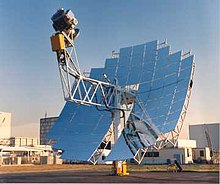
http://www.whispergen.com/content/library/whispergen.html
[Edited on 22/5/12 by coyoteboy]
|
|
|