
I'm fitting solar panels soon
JoelP - 1/1/24 at 07:27 PM
They are getting crazy cheap these days. So cheap that I'm going to ditch the feed in tariff and fit it myself. I think it would be about 7k more
to get a registered installer in. Here what I'm thinking of getting:
10x 425w panel at £99 each
2x 5.5kw inverters @ £690 each (conversol v7 from voltacon solar)
15kwh lithium battery from fogstar.com for £2.5k - crazy how cheap they've got.
That set up can also handle an extra ten panels on the other face of the roof, which I'll fit at tree end of the year to help meet winter
supply.
Under 5k to cover nearly all the electric I use, with enough spare in summer to cover hot water too.
Anyone end plotting diy solar?
JoelP - 1/1/24 at 07:29 PM
https://www.fogstar.co.uk/products/fogstar-energy-15-5kwh-48v-battery?pr_prod_strat=e5_desc&pr_rec_id=3af41eec6&pr_rec_pid=7214460665915&p
r_ref_pid=7082856087611&pr_seq=uniform
Slimy38 - 1/1/24 at 09:19 PM
I have to be honest, that 7K gives a whole lot of peace of mind. I really wouldn't know what would worry me more, setting up my own scaffolding
so I could drill holes in my roof and get these whacking great panels fitted and working without causing structural damage. Or knowing how to work
with electrickery to a level where the electric company would be ok me hooking up some extra currents to their meter.
That's just on the installation too, when I go for mine I'd want to know that for 10 years I could just phone up an installer and get them
to come take a look at any issues, leaks, power loss etc.
I like the idea of prices finally coming down, a quick Google for 15kwh batteries just shows that 2.5K is a fraction of typical market prices.
craig1410 - 2/1/24 at 02:54 AM
Hi JoelP,
I fitted my own solar PV and battery system last year and it has worked out great so far. Long story short I have 16 x 425W (6.8kWp) PV array made up
of Trina Vertex S 425W panels on my garage roof. They are coupled with a Victron Multiplus-II 48/5000/70-50 hybrid inverter via two 250/60 MPPT smart
solar charge controllers. The batteries are three US5000 modules from Pylontech and the have so far been flawless. Total capacity is 14.4kWh (13.68kWh
usable).
I live in Scotland and so the rules around electrical installations are a bit different domestically. There is no part-p and in my situation I can
basically do my own installation as long as I do it to BS7671 standards. I have the various regs, equipment and a degree in electrical engineering so
am pretty confident I can do just that.
That all said, you really must get G99 approval for your installation BEFORE you commission your system. Otherwise potentially your DNO (Distribution
Network Operator) can disconnect your supply. It's not that hard to complete your own application for G99 but if you want to get some help then I
would recommend https://g59projects.co.uk
G99 approval is a lot easier than it was when I started so don't be intimidated.
I've heard of fogstar and it's really nice to hear about UK based battery suppliers but I can't vouch for them since I have no
experience of them. Same for the inverters you mention. All I would say is to ensure by whatever means necessary that you maximise safety because high
voltage DC is even more dangerous than high voltage AC so you need to be very sure of the quality and integrity of your connections. Any bad
connections can easily start fires so don't scrimp on electrical safety.
My installation cost about £10k but would be around £7k today and despite NOT having MCS certification, I managed to get an export MPAN and tariff
from Octopus Energy, So I now get 15p/kWh from Octopus and have made over £80 this winter alone from the "Saving Sessions" that Octopus have
been running on behalf of the national grid. My primary aim was always self-consumption but in the summer I have more power than I can use to
it's nice to send the excess back to the grid.
So, yeah I think DIY solar is very much viable and increasingly attractive. Just make sure you either have the required skills and knowledge yourself
or bring in someone who has. They definitely DON'T need to be "MCS certified" in order to get an export tariff although Octopus do
charge £250 for non MCS approved installations.
If you do decide to switch to Octopus then if you use this link then we'll each receive £50: https://share.octopus.energy/bold-foal-39
Let me know if you have any questions.
ps. I suspect @Slimy38 is an MCS installer. 
Benzine - 2/1/24 at 07:58 AM
Good thread! Something I've thought about quite often. The area I live in has become a conservation area though, so I'm not sure if that
makes things more difficult.
Slimy38 - 2/1/24 at 09:17 AM
quote:
Originally posted by craig1410
ps. I suspect @Slimy38 is an MCS installer.
LOL, not even close! I've not approached any solar power stuff yet, I'm thinking about it as the next major house project but that's
about it. However I did work on telephone exchanges when I was doing my apprenticeship, and seeing a spanner literally evaporate when accidentally
connected across a battery pack, I'm all too aware of the dangers of high voltage DC.
That work was also covered by BS7671 albeit the 16th edition. From memory the regs are mainly common sense stuff, with a few tables to cross reference
for connector/cable sizes etc. A bit like the IVA manual for building a car? Buying a copy of the regs used to be very expensive, but I've just
checked and it's just over £100 which is actually quite reasonable now.
As with any DIY project if you have the confidence in your abilities and at least some knowledge in the regulations and standards then I encourage
doing it, I personally think it's outside my skillset. My wife is still complaining about the soffits that need fixing, so I doubt she'll be
letting me install my own solar!!
roadrunner - 2/1/24 at 10:08 AM
Hi Joel.
I purchased a 6kw DIY kit at the beginning of 2022 and installed it myself. Didn't get the batteries though, to expensive at the time.
It was really easy to fit, except for the height and working from a tower scaffold.
Even though it's classed as a DIY kit, it is exactly the same as set up as the Pro's install.
My best mate is an electrician and he did the technical bit wiring up to the consumer.
It's been one of the best addons I have done to the house.
russbost - 2/1/24 at 11:38 AM
I'm interested to hear what people have done with regard to get their kit signed off for G98 or G99, I've installed a load of solar &
batteries myself, but have kept it all off grid.
Been looking at helping my son in law with a fresh install from a DIY kit for his place, but I've spoken to 3 sparkies I know personally &
have put a considerable amount of work through in the past & they are all saying they aren't qualified to sign off a solar installation, that
it requires specific training/accreditation
I know someone who's installed an 8kW setup & simply not told the DNO, all very well unless something goes wrong, at which point I think
expensive litigation might start flying around
I've looked at doing a G98 install ourselves as you actually commission the system b4 you get it signed off (which seems pretty bizarre to me! )
- when you look at the form, it asks for the qualification of whoever is signing off & also asks what accreditation they have - whether anyone
ever actually looks at what's on the form or checks anything again I have no idea, but if you put anything falsified on there & it then did
go wrong, the outcome is not gonna be good
)
- when you look at the form, it asks for the qualification of whoever is signing off & also asks what accreditation they have - whether anyone
ever actually looks at what's on the form or checks anything again I have no idea, but if you put anything falsified on there & it then did
go wrong, the outcome is not gonna be good
Any personal experience or anyone on here capable (& happy to!) check over & authorise an installation I'd be interested in any info
russbost - 2/1/24 at 11:40 AM
Also @JoelP, where have you found 425W panels for £99 ea, sounds a lot cheaper than what I've seen?
roadrunner - 2/1/24 at 12:24 PM
quote:
Originally posted by russbost
I'm interested to hear what people have done with regard to get their kit signed off for G98 or G99, I've installed a load of solar &
batteries myself, but have kept it all off grid.
Been looking at helping my son in law with a fresh install from a DIY kit for his place, but I've spoken to 3 sparkies I know personally &
have put a considerable amount of work through in the past & they are all saying they aren't qualified to sign off a solar installation, that
it requires specific training/accreditation
I know someone who's installed an 8kW setup & simply not told the DNO, all very well unless something goes wrong, at which point I think
expensive litigation might start flying around
I've looked at doing a G98 install ourselves as you actually commission the system b4 you get it signed off (which seems pretty bizarre to me!)
- when you look at the form, it asks for the qualification of whoever is signing off & also asks what accreditation they have - whether anyone
ever actually looks at what's on the form or checks anything again I have no idea, but if you put anything falsified on there & it then did
go wrong, the outcome is not gonna be good
Any personal experience or anyone on here capable (& happy to!) check over & authorise an installation I'd be interested in any info
Getting mine signed off by the DNO was a bit of a surprise and expensive.
When I researched DIY fitting, nothing came up about the sign off and how expensive it might be.
If I'd stuck with a standard 3.8kw system it would have been free. But because mine was a 6kw set up the DNO have to check that the local grid
can cope with over amping. It can take up to 4 months. Unfortunately for the DNO, when I realized and contacted them I already had the system up and
running, so they pushed it through. It cost me another £400.
I had my install checked by the supplier of my kit, and because the electrical side had been signed off I got the MCS cert for another £400.
I have received just over a £1000 back from Octopus in the last year alone. Another year or two will see the panels pay for them selves.
The 6kw kit cost me £3600.
JoelP - 2/1/24 at 01:40 PM
Hi all. Thanks for the input, much appreciated. I didn't actually know it was possible to register for feed in payments on a DIY install. I was
just going to use offgrid inverters and not bother sending any back, therefore also not telling the dno. I'm a qualified electrician, plus I put
the roof on my house myself, so I guess I'm in a lucky position there!
I'll dig out a link for the panels now...
JoelP - 2/1/24 at 01:43 PM
It's a preorder for next month. Bifacial though, so even higher output if any light hits the back side, ie on a frame in the garden.
https://voltaconsolar.com/solar-panel/et-solar-panel-430w-bifacial-monocrystalline-half-cut.html
I should add that there's loads of panels at the £120-£130 mark. Prices are collapsing faster than you can keep up with.
[Edited on 2/1/24 by JoelP]
coyoteboy - 2/1/24 at 10:36 PM
@Craig, that's interesting to hear, every supplier I checked including octopus said mcs was an absolute requirement and they wanted the cert
number.
russbost - 3/1/24 at 10:37 AM
quote:
Originally posted by coyoteboy
@Craig, that's interesting to hear, every supplier I checked including octopus said mcs was an absolute requirement and they wanted the cert
number.
That's my understanding too, I'd be interested to see anything in writing from Octopus or anyone else regarding a non MCS install - a charge
of £250 would be a LOT less than the difference between an MCS/non MCS install at purchase
Mr Whippy - 3/1/24 at 01:10 PM
That looks a great price.
If the panel is facing East or West is it going to make a huge difference to the power output?? It's just my garage is ideal with a 50sqm area
apart from not facing south! However its not impossible to rotate it as the garage is 6 x 6m and I built it in the first place but it's a bit of
a pain.
JoelP - 3/1/24 at 03:59 PM
quote:
Originally posted by Mr Whippy
That looks a great price.
If the panel is facing East or West is it going to make a huge difference to the power output?? It's just my garage is ideal with a 50sqm area
apart from not facing south! However its not impossible to rotate it as the garage is 6 x 6m and I built it in the first place but it's a bit of
a pain.
Flat or pitch roof? I'd just pick whichever pitch is best, or if flat, just cover it with flat panels. Better flat than on frames and casting
shadows on each other.
Mr Whippy - 3/1/24 at 08:48 PM
quote:
Originally posted by JoelP
quote:
Originally posted by Mr Whippy
That looks a great price.
If the panel is facing East or West is it going to make a huge difference to the power output?? It's just my garage is ideal with a 50sqm area
apart from not facing south! However its not impossible to rotate it as the garage is 6 x 6m and I built it in the first place but it's a bit of
a pain.
Flat or pitch roof? I'd just pick whichever pitch is best, or if flat, just cover it with flat panels. Better flat than on frames and casting
shadows on each other.
sorry it's a 20 deg pitch with the gable facing south, a great simple roof but not really the best origination  the house does face the sun but
has dormers in the way.
the house does face the sun but
has dormers in the way.
craig1410 - 3/1/24 at 10:47 PM
quote:
Originally posted by russbost
I'm interested to hear what people have done with regard to get their kit signed off for G98 or G99, I've installed a load of solar &
batteries myself, but have kept it all off grid.
If you want good value PV panels, check out https://midsummerwholesale.co.uk/buy/trina/trina-425w
These are the panels that I bought in summer 2023 and they cost me twice that price at the time. I'm seriously considering buying another 16 to
put on my north facing roof because they are so cheap now!.
Another company I would recommend is https://essandsolarsolutions.co.uk who I bought all my Victron gear from. In fact I also bought my solar panels
from this company since they can get a bit of a trade discount from midsummer. The owner is called Etienne and he is a really nice guy and very
knowledgable. He will sell you a complete DIY solar/battery system if you want one, and will give you good advice on how to get it set up.
The G99 process isn't something you need to be intimidated by, especially for a typical domestic installation, as long as the equipment you are
installing is type tested on the ENA database here ( https://www.ena-eng.org/gen-ttr/ ). Have a look at this guidance document for more details.
Search for SGI-3 as that is most relevant for G99 installations: ( https://connections.nationalgrid.co.uk/downloads/24747 )
I have heard of several people getting G99 approval the same day they applied for it. For me it took longer but mostly because the fast track process
was more restrictive when I started AND my hybrid inverter was going through some type testing issues. Once resolved it was approved no problem. I
initially had to pay a £300 "design charge" to SP Energy Networks but this was later refunded as it had been charged in error.
Another forum thread worth reading is this one: https://community.victronenergy.com/questions/131033/uk-ess-self-install-mcs-certification.html and
https://community.victronenergy.com/questions/225189/now-open-to-all-no-more-mcs-needed.html
I'm on that forum as "Craig Chamberlain" and you will see a number of my posts as the whole Octopus non-MCS trial process kicked off. I
was told by a senior Octopus field engineer that I was the "first" trial customer for non MCS installations. Unfortunately, Octopus rolled
back a little bit after my installation was approved and introduced the £250 fee and now require some evidence of electrical installation and building
control authorisation. But if you follow "solar sam" on the above thread you'll see that Octopus will give you an export tariff if you
follow the non-MCS process.
@Slimey38 - sorry if I got you wrong but it just sounded like you were actively discouraging DIY installations. I see from your last post that this is
not the case. 
If anyone has any questions then please feel free to DM me or reply in this thread.
coyoteboy - 4/1/24 at 12:00 PM
Some good info there Craig, thanks! I've been planning a DIY install for a long time but thwarted by the MCS nonsense. My god, those panel prices
are so cheap! I have a 400W setup on my garage roof feeding batteries, the panels for that cost four times that $/Watt about 4 years ago.
Are you a qualified electrician or did you get it inspected?
Trying to find a list of the requirements is not easy. The G98/99/100 process is fairly clear but building regs requirements are less so (of course
structural reqs are obvious, but there's no list of electrical requirements to follow such that you'd know an electrician would be happy to
sign it off). In England I guess you'd follow Part P but in Scotland maybe that's guidance only? This is part of the problem with the MCR
scheme - the info is quite thoroughly hidden by gate-keepers under the "just use an MCS accredited person". I should spen an evening digging
further.
[Edited on 4/1/2024 by coyoteboy]
Mr Whippy - 4/1/24 at 12:34 PM
tbh at those process I don't think I care if the garage is facing south...
SteveWalker - 4/1/24 at 11:01 PM
ISTR reading that while South generates the most power, West provides the most power at times of peak need. The overall difference is West having 80%
of the output of South, but at a better time.
Mr Whippy - 5/1/24 at 07:21 AM
quote:
Originally posted by SteveWalker
ISTR reading that while South generates the most power, West provides the most power at times of peak need. The overall difference is West having 80%
of the output of South, but at a better time.
Thanks, that may be more useful as I don't intend on any battery storage (for now), just feeding back the excess to the grid to reduce the
overall bill. In summer that will power more than I need for the whole house easily. Need to look into exactly what is required.
craig1410 - 5/1/24 at 11:59 PM
quote:
Originally posted by coyoteboy
Some good info there Craig, thanks! I've been planning a DIY install for a long time but thwarted by the MCS nonsense. My god, those panel prices
are so cheap! I have a 400W setup on my garage roof feeding batteries, the panels for that cost four times that $/Watt about 4 years ago.
Are you a qualified electrician or did you get it inspected?
Trying to find a list of the requirements is not easy. The G98/99/100 process is fairly clear but building regs requirements are less so (of course
structural reqs are obvious, but there's no list of electrical requirements to follow such that you'd know an electrician would be happy to
sign it off). In England I guess you'd follow Part P but in Scotland maybe that's guidance only? This is part of the problem with the MCR
scheme - the info is quite thoroughly hidden by gate-keepers under the "just use an MCS accredited person". I should spen an evening digging
further.
[Edited on 4/1/2024 by coyoteboy]
Yeah PV panels prices have dropped considerably even since I bought mine. I think I paid something like £175 a panel inc VAT back in May 2023 and
those exact same panels are now £92 each inc VAT.
I’m not an electrician although I do have a degree in Electronics & Electrical Engineering so I understand “electricity” pretty well and have many
years experience of doing electrical jobs around my various houses over the years. The scope of what you need to know in a relatively modern house is
massively reduced compared to what you would need to know as a commercial electrician dealing with domestic and industrial installations. That said, I
take it very seriously and do a lot of reading and watch a lot of YT videos before I’m happy to proceed. I bought a copy of the 18th edition regs and
on-site guide and a bunch of other specialised books on ESS systems and have read them thoroughly. I also have a Megger multi function tester and
torque screwdriver and a bunch of other tools and equipment that are really needed to do a proper job. So, as a result, I feel as if, as long as stay
within my “comfort zone” in terms of scope, and take all the time I need to read, research and complete each job including all the testing, then I can
consider myself competent. I’ve no doubt that a really good electrician could do a better job but I also know that there are plenty of cowboy
electricians out there who would do a considerably worse job than me. I’ll probably get an EICR done just as a means to have a second pair of eyes
look over at least the AC side of my system.
We don’t have part p in Scotland and as long as you’re not working in building with more than ground and first floor, or a commercial building or some
other exclusions, then the scottish building control website says that you can pretty much do whatever electrical work you want. This is just my view
from reading the website though so this should not be taken as advice. If in doubt then talk to your local building control officer.
My PV panels are installed on a refurbished agricultural outbuilding roof and as part of that refurb, we replaced the fibre-cement/asbestos roofing
sheets with kingspan quadcore 80mm insulated panels. We also replaced all the timber purlins with new C24 graded purlins which were 25mm deeper (9”
instead of 8”). Comparing the weight of the old fibre-cement with the new insulated panels they are both stronger and lighter, and even with the solar
PV panels added, the roof loads are less than they were before. Since it’s an agricultural building, I don’t believe building control have any
interest in it anyway. If I had been installing the array on our house then I would definitely have got more advice in this area but I’m sure it would
have been fine as it was only built around 16 years ago.
In terms of electrical sign off, until relatively recently I think you only needed a new circuit installed for the inverter and then the inverter was
treated as an “appliance”. But in recent years BS7671 has started to cover more and more of the renewables stuff that previously only MCS covered.
That’s why in my opinion, MCS has had its time and is no longer necessary. Also, by removing MCS, it opens the door to hundreds of really good,
independent electricians who otherwise just can’t afford the bureaucracy of MCS accreditation.
HTH - sorry for the long post.
craig1410 - 6/1/24 at 12:34 AM
quote:
Originally posted by SteveWalker
ISTR reading that while South generates the most power, West provides the most power at times of peak need. The overall difference is West having 80%
of the output of South, but at a better time.
I hear what you’re saying and in cases where the occupants don’t adjust behaviour then it might be broadly true. However, I think a lot of people are
able and willing to make adjustments to consumption patterns to maximise use of renewables. Even simple things like using the timer on your dishwasher
or washing machine etc. Also, it’s more common these days for at least one occupant to work from home which changes usage patterns and provides
opportunities for further flexibility.
But the real game changer is of course to incorporate battery storage which then allows you the greatest flexibility and reduces the need to adjust
behaviour in many cases. This is especially so in late autumn through to early spring when the sun doesn’t get high enough in the sky for meaningful
generation unless the roof is south facing.
Today was a really nice sunny day in west central Scotland and our 6.8kWp array peaked at 2350W around 12pm and produced in excess of 1kW from 10am to
2:30pm. That’s pretty much as good as it gets at this latitude on a south facing 15 degree roof. Total generation today was 8.6kWh. If my roof had
been west facing I doubt I would have got even half that generation.
David Jenkins - 7/1/24 at 05:49 PM
quote:
Originally posted by craig1410
But the real game changer is of course to incorporate battery storage which then allows you the greatest flexibility and reduces the need to adjust
behaviour in many cases. This is especially so in late autumn through to early spring when the sun doesn’t get high enough in the sky for meaningful
generation unless the roof is south facing.
I fitted house batteries just over 12 months ago - a major difference! Mine charge overnight using Octopus Go (which I have for our cars) so, most of
the time, we run appliances during the day at off-peak rates (less than 1/3 cost per unit). In sunnier months we don't take much energy
overnight as PV tops it up all day so little is required to get back to 100%. In these months we also charge our cars during the day - and we get
paid for all electricity that comes off the roof (under an old solar payment scheme) so we get paid to charge the house and car batteries! No longer
possible under current schemes though...
It's nice to sit watching TV in the evening, seeing the total house grid load on the smart meter display varying between 0 and 100W most of the
time (usually near 0W).
But I won't open the debate whether house batteries are economic if you include the installation cost... still not cheap to fit.
craig1410 - 7/1/24 at 09:13 PM
quote:
Originally posted by David Jenkins
I fitted house batteries just over 12 months ago - a major difference! Mine charge overnight using Octopus Go (which I have for our cars) so, most of
the time, we run appliances during the day at off-peak rates (less than 1/3 cost per unit). In sunnier months we don't take much energy
overnight as PV tops it up all day so little is required to get back to 100%. In these months we also charge our cars during the day - and we get
paid for all electricity that comes off the roof (under an old solar payment scheme) so we get paid to charge the house and car batteries! No longer
possible under current schemes though...
It's nice to sit watching TV in the evening, seeing the total house grid load on the smart meter display varying between 0 and 100W most of the
time (usually near 0W).
But I won't open the debate whether house batteries are economic if you include the installation cost... still not cheap to fit.
Yeah same here, I fitted house batteries and commissioned them on 29th Oct 2022, initially purely for energy arbitrage via Octopus Go, but since I
installed solar PV panels in June 2023 and subsequently got my export tariff despite no MCS certificate in late July, I now also export energy at
15p/kWh. I am currently on the Intelligent Octopus Go tariff which gives me 7.5p/kWh off -peak from 11:30pm until 5:30am and 29.96p/kWh at other
times. It also gives off-peak energy at other times when there is excess grid energy. Even better, by opting in to "Saving Sessions" you can
earn anything up to 400p (yes £4) per kWh by reducing consumption and maximising export during the session times. I made £71.88 from 5 of these
sessions which lasted 5 hours or so in total. Even the basic 15p/kWh is pretty comparable to many of the FIT tariffs of the past and it's likely
to increase further in time. I started with 0p since I had no MCS cert, then got 4.1p, then 8p and now 15p, all since the start of August.
I've stopped charging our EV from solar generation because I can earn 15p from exporting and it only costs 7.5p to charge the EV overnight.
Better to export to the max during the day and charge the EV at night. I know how the old FIT tariffs work so what you're doing probably works
better for you. In the summer we have more power than we know what to do with and even in the winter our battery capacity is enough to get us through
the day on cheap rate power. Should pay for itself in 5 years or so.
Mr Whippy - 8/1/24 at 07:46 AM
Amazing stuff
tegwin - 8/1/24 at 12:22 PM
Really interesting thread, the prices are definitely at the point where its starting to make sense.
I had been eyeing up my garage roof as it would be easier to take the panels with me if I move. Its a gently sloping flat roof - I had thought about
using frames to give a good angle but how much difference would it make if the panels were basically flat?
craig1410 - 8/1/24 at 02:22 PM
quote:
Originally posted by tegwin
Really interesting thread, the prices are definitely at the point where its starting to make sense.
I had been eyeing up my garage roof as it would be easier to take the panels with me if I move. It's a gently sloping flat roof - I had thought
about using frames to give a good angle but how much difference would it make if the panels were basically flat?
Yeah I have been waiting a few years until the payback period became short enough for me to jump in but that point came over a year ago in my opinion
where the estimated payback dropped to around 5 years by my reckoning. A combination of high electricity prices and reducing PV and battery prices.
My garage roof where my panels are installed is only around 14 degrees slope and is 5 degrees west of due south. The optimal angle and direction would
be 41 degrees angle and 4 degrees west of south. What this means for annual generation for my system at my location is 5919.87 kWh / year vs 5488.16
kWh / year (optimum vs actual). That's 92.7% which isn't bad I think.
You can enter your own location and details into this tool to get a prediction: https://re.jrc.ec.europa.eu/pvg_tools/en/
JoelP - 8/1/24 at 06:16 PM
quote:
Originally posted by tegwin
Really interesting thread, the prices are definitely at the point where its starting to make sense.
I had been eyeing up my garage roof as it would be easier to take the panels with me if I move. Its a gently sloping flat roof - I had thought about
using frames to give a good angle but how much difference would it make if the panels were basically flat?
An easy approximation of the percentage efficiency is 100cos x, where x is the angle away from ideal. Presuming you're in the UK, 55 degrees from
horizontal is a start. Bearing in mind you'll have a huge surplus of power in summer, you could argue the panels should be optimised for winter,
and installed more vertically.
craig1410 - 8/1/24 at 10:24 PM
quote:
Originally posted by JoelP
An easy approximation of the percentage efficiency is 100cos x, where x is the angle away from ideal. Presuming you're in the UK, 55 degrees from
horizontal is a start. Bearing in mind you'll have a huge surplus of power in summer, you could argue the panels should be optimised for winter,
and installed more vertically.
Something else to bear in mind is that, if you don't have a perfectly south facing roof then steeper panels exaggerate the reduction in
efficiency. To visualise this, consider a completely flat array (ie. 0 degrees elevation). An array like this doesn't matter which direction it
is facing because the sun can shine on it from any angle (assuming no shading of course). Now consider an array where the panels are mounted
vertically and you'll realise that it becomes much more sensitive to deviation from due south.
In addition, if you are considering mounting the panels on some sort of frame to increase the angle then this will have an impact on wind loading and
if the top row of panels are higher than the apex of the roof then you might have issues with planning permission.
My advice would be to keep the panels low to the roof to minimise wind loading and avoid planning issues. The reduction in efficiency really
isn't that much and if you have the space on the roof then you can probably just add another panel or two to compensate. I'm at 55.7
latitude and still managed to get 3136W peak today at 12:43pm from a 6800W array. Total generation was 5.8kWh for the day. Not bad for January 8th!
In other news, we had a nice surprise from our Intelligent Octopus Go tariff this evening. My wife plugged the EV in at around 5:30pm and Octopus
created a schedule to charge the EV starting at 7:30pm and running through to 6:30am tomorrow morning. That means that ALL consumption between those
times is at the off-peak 7.5p/kWh rate. So of course we have charged the home batteries and EV batteries up to 100% and ran the dishwasher and washing
machine. That's the longest "smart charge" session we have seen yet and basically means we can run from the grid until 6:30am and then
start to deplete the batteries. Tomorrow looks like another sunny day so should be able to export PV energy for a good 3-4 hours in the middle of the
day.
If anyone fancies switching to Octopus and sharing a £100 credit then use this referral link. https://share.octopus.energy/bold-foal-39
Mr Whippy - 9/1/24 at 07:42 AM
Fantastic information guys
That calculator is great too, it's amazing at how much power it predicts per month, a real eye opener. Looks a fantastic project to take on in
the spring. Thanks.
jacko - 12/1/24 at 07:11 PM
Don’t forget to fit netting to stop pigeons they love solar panels
G
David Jenkins - 14/1/24 at 11:54 AM
quote:
Originally posted by jacko
Don’t forget to fit netting to stop pigeons they love solar panels
G
Yep. I've just paid a bundle of money for a firm to clear out all the dove nests under my panels, and to fix wire mesh all around...
No way I was going to get on the roof to do it myself - I know my limitations!
coyoteboy - 15/1/24 at 10:46 AM
Mine are too close to the roof for them to get under.
craig1410 - 17/1/24 at 06:43 PM
quote:
Originally posted by coyoteboy
Mine are too close to the roof for them to get under.
Same here - it's on a steel trapezoidal section roof so very minimal gap. Might still be a problem for smaller birds like swallows so might add
some bird protection before they start nesting but I doubt it'd be a problem.
MarcV - 23/1/24 at 08:44 PM
What is the slope of the roof?
For a flat roof you should consider that you'll generally end up with rows of panels. So you don't want too much slope on the panels as they
will stick up and cast a shadow over the next row. Especially in winter this is an issue and that is where you'll need the energy most.
As example I have just rotated a set of panels on our roof. Now I have one set facing SE, the other SW. Tilt is some 5 degrees, barely enough to keep
themselves clean. Anyway, when the sun is in SE, the SW panels make most energy as they don't have shadow of the other rows. In a little while
the sun will be high enough to make SE panels more efficient with SE sun.
Optimising for winter is hard on a flat roof. But depends on the area and orientation you have available. I wouldn't put panels any flatter than
5 degrees, water and dirt will remain on them.
craig1410 - 24/1/24 at 12:51 PM
quote:
Originally posted by MarcV
What is the slope of the roof?
For a flat roof you should consider that you'll generally end up with rows of panels. So you don't want too much slope on the panels as they
will stick up and cast a shadow over the next row. Especially in winter this is an issue and that is where you'll need the energy most.
As example I have just rotated a set of panels on our roof. Now I have one set facing SE, the other SW. Tilt is some 5 degrees, barely enough to keep
themselves clean. Anyway, when the sun is in SE, the SW panels make most energy as they don't have shadow of the other rows. In a little while
the sun will be high enough to make SE panels more efficient with SE sun.
Optimising for winter is hard on a flat roof. But depends on the area and orientation you have available. I wouldn't put panels any flatter than
5 degrees, water and dirt will remain on them.
Hi, not sure if your question was directed at me but my roof is 14-15 degrees pitch so more than enough to keep the panels clean naturally. Here is a
photo:
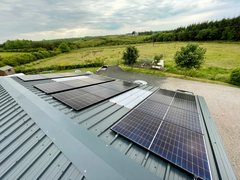
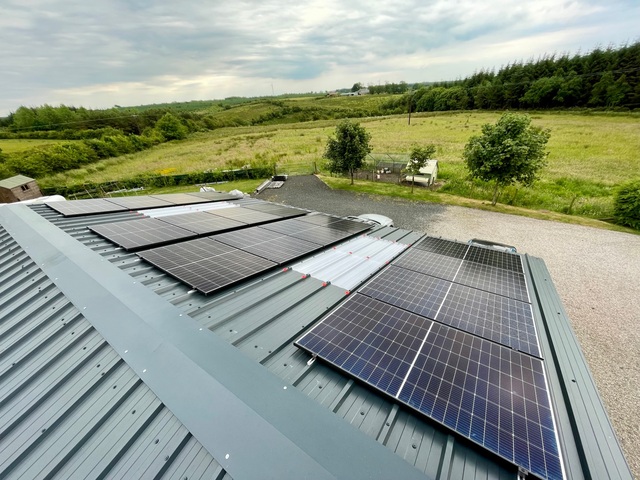
PV Array
And one during the roof refurb (do you like our home made staircase to carry the 60Kg roof sheets into position )
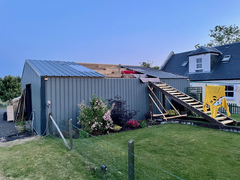
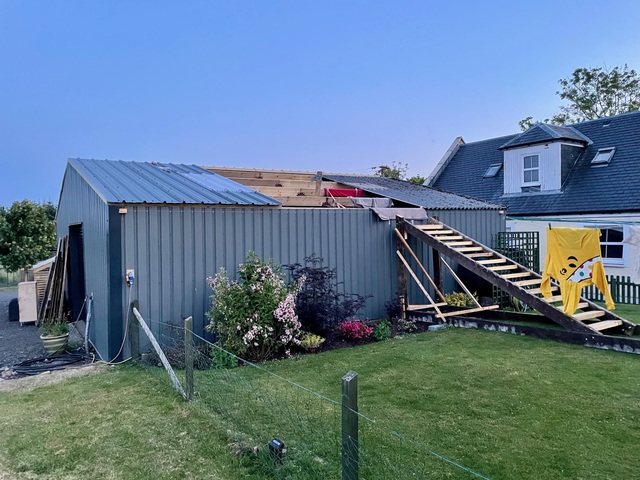
Description
I agree that tilting panels on a roof will require extra spacing between rows and this would certainly have caused me a problem since I didn't
have much spare room up the roof for that spacing. You need to stay away from the roof edges by 300-500mm to reduce wind loading and you don't
want your panels to be higher than the roof apex for planning permission reasons either.
I'm pretty lucky to have a due-south facing roof (actually it's 4 degrees west of south which is actually better according to the solar
prediction tool) and the pitch, although not idea, made the installation much easier than if it was a steeper pitch, and doesn't reduce
efficiency very much either. We didn't need to bother with scaffolding since as long as the roof was dry, it was pretty safe to walk around up
there as long as you take care near the edges and around the roof lights. My wife and I actually installed the entire roof on this building in the
summer last year as well as the solar panels so we're quite proud of ourselves! I was a bit nervous in recent days with the 70+MPH wind gusts
but so far all good. I did go around the bottom row of PV clamps with the torque wrench a few days ago just to check they were still tight (13NM)
which they were. I also used extra long screws (160mm) when installing the 80mm thick insulated roof panels, and added extra, "optional",
screws.

