Miks15
|
| posted on 11/4/11 at 12:00 PM |

|
|
I do love how you start with : Lets keep it simples
and end with rotational inertia comes in to play 
The simplest way to look into it would be no friction, no air resistance, purely the moving of an object down a plane.
Also when you say the heavier will travel furthest, what are you basing that on? Yes it was more potential energy, but it also has more kinetic when
moving due to both benig a function of mass.
So when a falls x meters, GPE has dropped by some amount, but kinectic energy has increased by the same amount.
Same goes for the other ball.
I still believe that if it was an infinite plane, both balls would be neck and neck the entire way, assuming friction coefficient is low and not the
extreme grass bank.
quote:
Originally posted by 02GF74
quote:
Originally posted by graememk
If you put to balls of the same size on a slope
1. Which one will accelerate faster the light one or the heavy one?
2. Which one will be going faster at the bottom of the hill?
3. Which one will travel further?
let's not get bogged down with blades of grass, friction, air resistance, densitiy distribtion etc. but keep it simples.
1. both should experience same accelerating force = gravity *
2. same speed due to 1
3. heavier one will travel further due to having more poential energy
* That is certainly true when in free fall but I am wondering about this since balls rotate when rolling along a surface so rotational inertia
comes into play.
|
|
|
|
|
hughpinder
|
| posted on 11/4/11 at 01:01 PM |
|
|
Here's my take
2 balls, A=1kg, B=2kg
iniital potential energy =mgh, since g and h are the same B has twice the kinetic energy.
Assume no surface friction, no air friction and no relativistic effects and let the balls roll down the slope.
The potential energy is changed to kinetic energy. Start at 1m high
A has 9.8 joules, so 0.5*m*v*v = mgh = 9.8, actual speed will be approx 4.4m/s (SQRT of 19.6)
B has 19.6 joules, so 0.5*m*v*v =19.6, actual speed will also be 4.4m/s (mass is 2 remember)
In ideal conditions the mass cancels out and they achieve the same speed. There are no frictional losses, so they keep going forever, and will always
have travelled the same distance in the same time.
However, ball B has more kinetic energy and also more momentum. If you are loosing constant energy/second to friction (assuming the frictional forces
are not dependant on normal forces like with a tyre) then the lighter ball will run out of kinetic energy first. The momentum of the heavier ball
means it overcomes the irregularities of the surface easier too. As a coupe of people have mentioned, gravity racers always go for absolute maximum
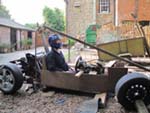
weight. We did one at belchford last year with 2 drivers in the same kart, but 15kg difference in our driver weights(about 6% of the overall mass),
and the heavier driver was about 2 to 3 seconds quicker down the course.
Regards
Hugh
|
|
|
02GF74
|
| posted on 11/4/11 at 01:11 PM |
|
|
quote:
Originally posted by Miks15
I do love how you start with : Lets keep it simples
and end with rotational inertia comes in to play
what I meant was to ignore environmental factors but concentrate on fundmentals.
e.g. air resistance is envionmenalt, it exists on earth but on the moon for example, there is no air so this can be discounted whereas inertia is a
function of mass and will alwyas be there no matter where you are in the universe.
thinking about it some more it is not going to be simple; for example if we ignore air resistance and friction, as I prevolsy suggested, then the
balls will never stop rolling so we do not know the answer to 3.
if we ignore friction then the heavier ball will roll further since air resistance is same for both. the heavier ball wil have more energy to start
with (potential = mgh) and if I recall correclty, inertia (resistance to motion) does not use up energy.
|
|
|
Miks15
|
| posted on 11/4/11 at 01:39 PM |
|
|
i understand what you meant, just didnt sound simple
Ive just had a rethink (again! ha) and now i reckon the heaviest will be going fastest at the bottom because air resistance is only a function of
velocity and has nothing to do with mass, so both will have the same force applied at the front from the air resistance which will reduce the
acceleration quicker in the lighter ball. The friction is a function of mass so assuming no air resistance and only friction they would be going the
same speed.
|
|
|
David Jenkins
|
| posted on 11/4/11 at 02:54 PM |
|
|
If you want a bit of variety...
Take a round ball and a cube - both made of the same material and the same weight. Both are nice and shiny.
Put them at one end of a flat, smooth board, then lift that end slowly.
Which one will get to the bottom first?
.
.
.
.
.
.
.
.
.
.
.
.
.
.
.
.
.
.
Usually, it will be the cube (if you lift too far, they'll probably arrive together, when gravity has more effect than friction/rotation). The
ball has to convert potential energy into rotational energy, whereas all the cube has to do is slide.
I didn't believe it until I saw a live demo!
|
|
|
02GF74
|
| posted on 11/4/11 at 03:39 PM |
|
|
^^^ I need to think about that but don't want to.
they may be going same speed when the leave the ramp but I still reckon the lighter one gets there fisrt due to inertia (it will take longer for the
heavier ball to start rolling).... as hinted at by DJs post above.
|
|
|
David Jenkins
|
| posted on 11/4/11 at 03:55 PM |
|
|
quote:
Originally posted by 02GF74
^^^ I need to think about that but don't want to.
they may be going same speed when the leave the ramp but I still reckon the lighter one gets there fisrt due to inertia (it will take longer for the
heavier ball to start rolling).... as hinted at by DJs post above.
I was also wondering whether the heavier ball would use more energy in rotation than the little one - and therefore arrive second.
|
|
|