blakep82
|
| posted on 29/5/09 at 10:55 PM |

|
|
drawbacks of different cooling systems
given that i won't be driving my car long distance, so really just around town, up into the hills, to work etc i'm thinking about
different ways of doing the cooling system.
ideally i'd like just a radiator top hose and bottom hose into the engine. done 
whats the draw backs of not having expansion bottles? old minis, my dads aerostar van he used to have with a 3 litre v6, and a few others didn't
have expansion bottles, so is it a case of they'll lose water and need checked more often? i can live with that. if i was to drive long
distance, the water level will only be a problem once it cools down won't it?
I'm running out of places to mount an expansion bottle. the only places i've got are not the top of the circuit
________________________
IVA manual link http://www.businesslink.gov.uk/bdotg/action/detail?type=RESOURCES&itemId=1081997083
don't write OT on a new thread title, you're creating the topic, everything you write is very much ON topic!
|
|
|
|
|
D Beddows
|
| posted on 30/5/09 at 12:40 AM |
|
|
You're talking about a header tank rather than an expansion bottle  Something of a can of worms this one as people seem to refuse to call
things by the right name - a header tank has the pressure cap on it, it can be an integral part of the radiator (ie the top bit) or it can be remote
but should always be the thing that has the (only) pressure cap on it. Something of a can of worms this one as people seem to refuse to call
things by the right name - a header tank has the pressure cap on it, it can be an integral part of the radiator (ie the top bit) or it can be remote
but should always be the thing that has the (only) pressure cap on it.
You obviously need something with a cap to pressurise the cooling system but you don't absolutely need a remote tank if the radiator
you're using has a pressure cap. The advantages of a remote header tank at the highest point are that it makes the cooling system much easier to
bleed and you can usually see the level of coolant in the system . The alternative if you radiator has the pressure cap is to have an expansion bottle
(which can be at any level really) to provide a reservoir to collect any coolant pushed out of the system past the pressure cap when it overheats and
pushes the cap open so it can then be pulled back when the system cools and the pressure drops therefore theoretically maintaining a constant amount
of coolant in the system.
Historicaly lots of production cars have worked perfectly well with a pressure cap on top of the radiator and an expansion tank to catch the overflow
so, in answer to your question, yes it should work as long as you're confident you can bleed the cooling system well enough but no, it's
very unwise to try and do without at least an expansion bottle
|
|
|
nitram38
|
| posted on 30/5/09 at 12:49 AM |
|
|
Systems without an expansion bottle tend to lose water over time which in turn causes more water loss.
In the old days, a top up bottle was added to rad cap outlets to catch any expelled water and as the system cooled, it draws the expelled water back
into the system.
Far and above the best system is the expansion bottle.
Not only does it have an airspace for the water to expand into when hot, being at the top of the water system (and plumbed correctly) it will remove
air from the system too.
Air in the system is bad as it expands when hot and can cause hot spots in the engine leading to cracked heads etc.
If you couple the expansion bottle with a float switch, then you can wire a warning lamp to give you an early enough indication that you are losing
water which may just help you save your engine.
In other words, do your utmost to fit an expansion bottle as it could save you a lot of hassle later.

|
|
|
D Beddows
|
| posted on 30/5/09 at 01:09 AM |
|
|
lol, that just proves my can of worms theory  Nitram is 100% correct but an expansion bottle is at atmospheric pressure and he is in fact talking
about a header tank. His top up bottle is actually the expansion tank. Nitram is 100% correct but an expansion bottle is at atmospheric pressure and he is in fact talking
about a header tank. His top up bottle is actually the expansion tank.
I know I'm being a bit pedantic but I spent 6 months of my life researching vehicle cooling systems for my degree dissertation many years ago.
The theory behind it all isn't rocket science by any means, the hardest part is working out what people actually are referring to when they talk
about header and expansion tanks
|
|
|
nitram38
|
| posted on 30/5/09 at 03:26 AM |
|
|
As far as I am aware:
A top up bottle is just a small container with some water in with a tube that comes from the radiator cap overflow that just goes into the container
below the water level. This will crudely top the system up but requires checking often
A header tank is normally a metal box with a standard radiator cap that acts as filling point and just fits in the top hose of the system. It has
constant full flow through it. Requires taking the cap off to check level
An expansion bottle is usually made of nylon/opaque plastic and has a pressure cap. It has two pipe entries, one smaller pipe at the top of the tank
and a slightly larger pipe at the bottom.
The difference to the header tank is that these two hoses are plumbed across the flow and return of the radiator/engine to create a smaller flow
through it.
The top hose can also be T'd off to several points including directly to the top of the radiator or the engine or any other airtrap point in
the outward flow from the engine.
Advantages are:
Visual level check without opening system to check.
Expansion of water into space so no water ejected.
Constantly removes air from the system to the top of the bottle.
For me the advantages of an expansion bottle out-weigh the extra effort in fitting.
|
|
|
tomblyth
|
| posted on 30/5/09 at 04:46 AM |
|
|
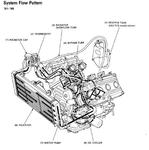
Mine has a expansion tank see my archive for drawing.
link
and it does not need to be high in the system (could be on the floor if you like) as there is a two way cap in the thermostate housing!
[Edited on 30/5/09 by tomblyth]
|
|
|
nitram38
|
| posted on 30/5/09 at 08:57 AM |
|
|
No it is not an expansion tank......it even says Reserve tank in your picture!
It is basically a top up tank that is not under any pressure from the plumbed system.
[img][/img]
|
|
|
blakep82
|
| posted on 30/5/09 at 12:38 PM |
|
|
cheers guys
looks like its going to be more complicated than i hoped then... the radiator itself doesn't have a pressure cap on it, so looks like i'll
need a header tank (? ) the radiator itself has 3 connections to it, top and bottom hose obviously, and a 3rd one which is only 8mm. the radiator
doesn't have a pressure cap on it.
i had thought about using one of those hose adapters you can get to put a pressure cap in the top hose, although i can't seem to find them
anywhere now. then i could hopefully go for an expansion bottle instead? as it can be placed anywhere.
________________________
IVA manual link http://www.businesslink.gov.uk/bdotg/action/detail?type=RESOURCES&itemId=1081997083
don't write OT on a new thread title, you're creating the topic, everything you write is very much ON topic!
|
|
|
nitram38
|
| posted on 30/5/09 at 12:44 PM |
|
|
Expansion and header tanks go at the highest point in the system.
Top up bottles can go lower but not too far from the rad cap.
|
|
|