johnemms
|
| posted on 30/11/11 at 05:23 PM |

|
|
Vaccum advance
http://www.gofastforless.com/
You're probably thinking, "Sure there is no manifold vacuum at WOT but aren't I supposed to use ported vacuum for the vacuum
advance." Hold onto your hat, THEY ARE THE SAME THING! Except ported is shut off at idle. There are a lot of misconceptions when it comes to the
ported vacuum source. After hearing 20 different theories I decided to hook up two vacuum gauges, one to manifold and one to ported, then drive my car
and watch it. I found out they are the same, except the ported is shut off when the throttle is closed. Even then I had a hard time convincing guys so
I hooked up a couple MAP sensors and a throttle position sensor to a data logger and recorded them while driving then dumped it into a spreadsheet and
made a chart. As you can see, there is a direct relationship between throttle position and vacuum. When the throttle is closed vacuum is high, when
the throttle is open vacuum is low, and ported vacuum is the same as manifold except when the throttle is closed. So which one do you want to hook it
to? I prefer manifold vacuum. This pulls in more timing at idle which is good since there is virtually no load. Your motor will idle smoother and
cooler with the extra timing. One night I was at the drags and my car was running hot in the staging lanes, I swapped the vacuum advance from ported
to manifold then it would idle all night at 175°. Believe it or not the purpose of ported vacuum is to raise the temperature at idle, to lower NOx
emissions. If you're like most hotrodders that is of no concern to you. If you have a big cam with a choppy idle then a vacuum advance hooked to
manifold vacuum can really help. It will idle smoother and requires less throttle to maintain speed. Often a big cam requires you to open the throttle
so far that the curb idle adjustment needles won't work. Hooking the vacuum advance to manifold vacuum will allow you to close the throttle some
which may be enough for the idle mixture screws to work. Someone told me he noticed less dynamic braking with the vacuum advance hooked to manifold. I
didn't notice it on my car but it makes sense. If the motor is running more efficiently with the added advance it will make a less effective
brake. So which should you use? Try both and see which you like best.
[img]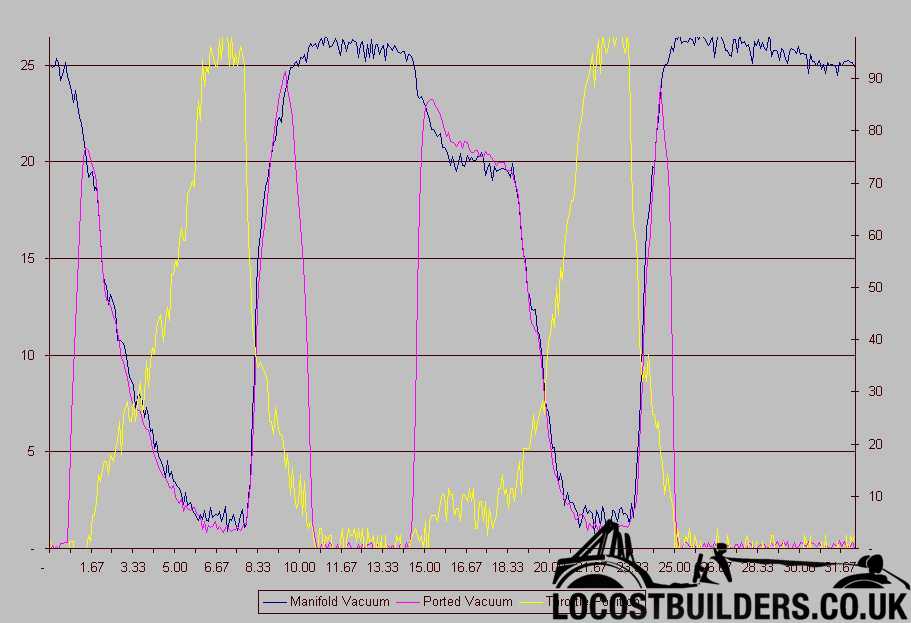 [/img] [/img]
I have fitted a small ajustable valve to the vaccum pipe and have almost no pulsing and a working vaccum advance off the manifold ... think i'm
getting there slowly... need to set maximum centrifugal advance next.. then advance curve 
[Edited on 30/11/11 by johnemms]
|
|
|
|
|
Bare
|
| posted on 30/11/11 at 06:57 PM |
|
|
A labor of Love? You seemingly have the test equipment. So electrical gizmos are familiar at least.
So where did you find an engine old enough to have a Distributor?
Or more to the point, worthy of the effort required? :-)
|
|
|
johnemms
|
| posted on 30/11/11 at 07:16 PM |
|
|
I found this and thought this may be of interest to anyone using webers - dellortos ? Oddly i've been on this forum for a fair few years and
the only answer to vaccum advance is 'oh we leave it off'.. it seems that after digging i now know the difference between a ported and
manifold takeoff and its uses... I suppose i could just 'buy' a complete engine and stick it in.. hell .. why not just buy a finished car
and pretend I know how it works.. yep this is love .. I love cars.. engines etc.. Its fun...I'm happy doing what i DO.. Hope this article helps
someone 'building' a car ... Jon
[Edited on 30/11/11 by johnemms]
[Edited on 30/11/11 by johnemms]
|
|
|
theduck
|
| posted on 30/11/11 at 09:42 PM |
|
|
I wish I understood more of that than I do. I guess it's to do with ignition advance being controlled by a vacuum pipe connection to the
distributor but then I'm lost.
|
|
|
paulf
|
| posted on 30/11/11 at 09:42 PM |
|
|
The main reason for vacuum advance is part throttle economy,I used it on throttle body's for a while as i think it is a better way of judging
engine load than throttle position. What I found was that even with linked ports with restrictors and damping chambers there is to little resolution
to determine the throttle position apart from idle , just open and full load as the vacuum drops off to quickly with any throttle opening .
I eventually settled on using alpha n mapping, even though theoretically speed density is better.
Paul
quote:
Originally posted by johnemms
I found this and thought this may be of interest to anyone using webers - dellortos ? Oddly i've been on this forum for a fair few years and
the only answer to vaccum advance is 'oh we leave it off'.. it seems that after digging i now know the difference between a ported and
manifold takeoff and its uses... I suppose i could just 'buy' a complete engine and stick it in.. hell .. why not just buy a finished car
and pretend I know how it works.. yep this is love .. I love cars.. engines etc.. Its fun...I'm happy doing what i DO.. Hope this article helps
someone 'building' a car ... Jon
[Edited on 30/11/11 by johnemms]
[Edited on 30/11/11 by johnemms]
|
|
|
Dusty
|
| posted on 30/11/11 at 09:54 PM |
|
|
Idle is not the only time you have the throttle closed. With manifold vacuum, imagine 6000 rpm, jump on the brakes. For a moment you have 32 degrees
centrifugal advance and with a closed throttle another 12 degrees of vacuum advance making 44 degrees total but with low cylinder filling. Could this
cause any problems? Would there be problems at say 2500 rpm?
PS Nice bit of research. Not the result I expected.
[Edited on 30/11/11 by Dusty]
|
|
|





.jpg)