Surrey Dave
|
| posted on 9/11/06 at 11:38 PM |

|
|
Why K series head gaskets in Rover?
How come the K series has a bad reputation when fitted to a Rover , and seems to be fine in an MG or Lotus Elise
|
|
|
|
|
MikeR
|
| posted on 9/11/06 at 11:50 PM |
|
|
there was a big problem with rover supplying plastic dowels and something else with the head gaskets for a while. Supposedly in mid 2002(ish) they
changed back to metal dowels to locate the head gasket and they're fine since.
(as long as you use the proper rover coolent and change it at hte proper interval)
(this is internet wisdom and could be complete tosh)
|
|
|
Stu16v
|
| posted on 10/11/06 at 12:09 AM |
|
|
quote:
Originally posted by Surrey Dave
How come the K series has a bad reputation when fitted to a Rover , and seems to be fine in an MG or Lotus Elise
Who told you that then? An Elise owner?
The only manufacturer that from memory has *ever* admitted to any problem was LandRover (Freeloader)
The very last of the Rovers suffer too, metal dowels or not. A lass from work bought a few months old MG ZR(?). 9000 miles on the clock and it was in
under warranty for a head gasket Luckily she bought it from a used car franchise, because she bought it just two weeks before Rover went pop Luckily she bought it from a used car franchise, because she bought it just two weeks before Rover went pop
Dont just build it.....make it!
|
|
|
nitram38
|
| posted on 10/11/06 at 12:23 AM |
|
|
The real reason head gasket failure occurs is lack of coolant and the poor location of the temperature sender.
When there is a lack of coolant through leaks etc, something strange happens on the temp gauge.
First it rises then falls back to normal.
This is because the lost water no longer surrounds the temp gauge and the gauge returns to normal readings.
The temp sender is located in the top outlet pipe, whereas other engines are actually tapped into the head.
This means that even if the head is cooking, the sender is in the wrong place to measure anything.
The driver continues driving as they believe everything is ok. The engine cooks while they are blissfully unaware.
The only clue now is the smell of burnt oil.
The elise and later rovers had a modified expansion bottle and float switch with a low water level warning light on the dash.
It comes on.........you check the engine.
The 1800 engine is worse because of the block is the same as the 1400, but the wet liners are bigger. This means less area for water in the block and
more heat to disipate.
After my recent loss of water and headgasket failure, I thought my engine was ok when I was driving, because my capilary gauge first went up and then
returned to normal.
I assumed it was air in the system.
I have now fitted the MG expansion bottle with float and a bright warning light on the dash.
Because my car is rear engined, I don't even see steam if I lose water. Fortunately, since the head gasket replacement, everything is now
fine.
[Edited on 10/11/2006 by nitram38]
|
|
|
bimbleuk
|
| posted on 10/11/06 at 05:19 AM |
|
|
Thermal shock from a poorly positioned thermostat was a big facor especially in mid-mount applications. Head gasket design and liner movement at high
RPM also didn't help. The later head gasket had a crush ring which helped to resist the liner "cookie cutting" the head gasket!
|
|
|
spaximus
|
| posted on 10/11/06 at 07:39 AM |
|
|
What Nitram says is spot on. My wife had her head gasket go (out of warrenty at 23000 miles). That was replaced along with the head skim etc at a cost
of £800. Since then she has had a manic view of watching the temp gauge and sur enough this week the same thing happens. The heater valave under the
dash leaked and the level dropped, temp gauge does the dance and she stops. This time the head gasket is okay but still a £200 bill. Car going next
week for an MR2, which is a shame as it is a nice car let down by the silliness of the design. Brown and Gammons do a conversion where the bottle
header is modified to take a low level sender. The block being bored also gives a rise to the possibility of liner walk if there are any misalignments
which can lead to head gasket problems.
|
|
|
StevieB
|
| posted on 10/11/06 at 08:39 AM |
|
|
quote:
Originally posted by Surrey Dave
How come the K series has a bad reputation when fitted to a Rover , and seems to be fine in an MG or Lotus Elise
They were really bad in Elises - mine overheated all the time and it's a lucky owner who manages to get much lifetime from the first engine
(unless they are clever and fit uprated gaskets before there's any problems)
|
|
|
clockwork
|
| posted on 10/11/06 at 10:07 AM |
|
|
Change the dowels, the headgasket and relocate the thermostat. All suggested on seloc forums. When I had my elise I was told to wait till the
temperature guage read 80+ before hammering it.
I still think the K-series is a brilliant engine, even though I lost one to cam tensioner bearing failure.
Shame they didn't nail the HGF problem earlier as it put soooo many people off Rovers.
|
|
|
nitram38
|
| posted on 10/11/06 at 10:35 AM |
|
|
Where do you relocate the thermostat?
Do you remove the original and put in a remote one?
|
|
|
bimbleuk
|
| posted on 10/11/06 at 12:19 PM |
|
|
If I remember correctly the thermostat is usually on the block under the inlet manifold. The remote thermostat is spliced in to the return hose from
the radiator. Where the hose comes out of the sill in the engine bay.
|
|
|
Coose
|
| posted on 10/11/06 at 05:08 PM |
|
|
Remove the thermostat, head gasket, head, block, gearbox and clutch. Replace with a Honda or Toyota! 
Spin 'er off Well...
|
|
|
britishtrident
|
| posted on 10/11/06 at 05:24 PM |
|
|
OK here are the facts.
Before saying anything else I would like to point out that the 1.8 is no more prone to head gasket failure than the 1.6.
The only mode of failure I have seen in later Rover K16 head gaskets is blowing out of the silcone sealer tracks between the waterways and the oil
ways. Once this goes the water gets dumped into the oil and if the engine is run water stops circulating and the engine cooks, and the sealing rings
of the gasket may blow or the liners sink into the block.
The initial blowing out of the sealant tracks occurs for one of two reasons.
(1) Slow loss of coolant from the inlet maniold gasket, or from hose clips or radiator.
(2) Over revving or over loading the engine when stone cold before he thermostat opens --- the k16 thermostat is unusually located. Around 2001
Rover introduced a modified (external) PVR thermostat installation for the 75 and MGTF opens on flow pressure as well as temperature.
Ford did not adopt this on the Freelander on cost ground. However a very simple alternative is to drill one or two 1/8" dia hole in the
thermostat valve plate which makes the thermostat respond quicker to block temperature at the expense of a longer warm up.
There was also a production tolerance issue with some 1.6 and 1.8 engines with alloy sumps, the head bolt threads were fouling in the block ladder
before being screwed fully down, this issue was however fixed in production before the R 75 production switched to Longbridge.
There were also seperate issues with the installation of the 1.8 in the Freelander and working practices at the Ford owned plant.
|
|
|
StevieB
|
| posted on 10/11/06 at 06:29 PM |
|
|
quote:
Originally posted by Coose
Remove the thermostat, head gasket, head, block, gearbox and clutch. Replace with a Honda or Toyota!
Even Lotus have done that - all Toyota engines across the range now. Makes far more sense, since the build quality isn't up to all that much
anyway, might as well at least use reliable engines!
|
|
|
Coose
|
| posted on 11/11/06 at 12:24 AM |
|
|
quote:
Originally posted by StevieB
quote:
Originally posted by Coose
Remove the thermostat, head gasket, head, block, gearbox and clutch. Replace with a Honda or Toyota!
Even Lotus have done that - all Toyota engines across the range now. Makes far more sense, since the build quality isn't up to all that much
anyway, might as well at least use reliable engines!
Eggsactly! Stick with proper Jap power - they know the score.... For more information, please consult the BEC area!
[Edited on 11/11/06 by Coose]
Spin 'er off Well...
|
|
|
coozer
|
| posted on 11/11/06 at 06:51 PM |
|
|
You need a Klinger head gasket fitted and then thats it, no more worrying...
1972 V8 Jago
1980 Z750
|
|
|
MikeRJ
|
| posted on 11/11/06 at 11:53 PM |
|
|
quote:
Originally posted by coozer
You need a Klinger head gasket fitted and then thats it, no more worrying...
That only applies to the Rover T-Series whose original gaskets were reknown for leaking oil. The Klinger gasket fixes this problem.
The latest and best K-Series gasket is made by Federal Mogul IIRC.
|
|
|
DEAN C.
|
| posted on 13/11/06 at 06:38 PM |
|
|
M and T series leaked oil at the rear of the head quite often harmlessly, and the K series are prone to leak oil into the water.
I can remeber when buying Rovers in bulk it was hard to find a K series without black scum in the header bottle.
I'll keep quiet now as its well known that I dislike K series with a vengeance.
Strange how I fitted a Toyota 4age in my Indy when at the time I had dozens of free K series engines sitting in my yard at the time.
Once I've finished a project why do I start another?
|
|
|
Miek
|
| posted on 14/11/06 at 07:31 PM |
|
|
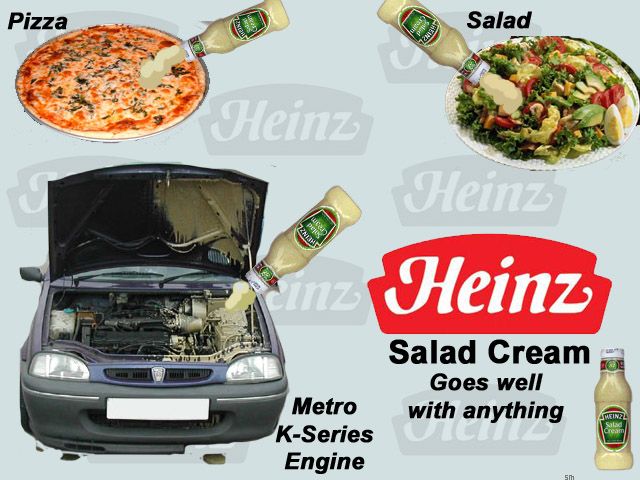
Someone on another forum's Metro went rather spectacularly. Basically, the header tank blew the whole oil/water mixture out, imagine seeing that
when you opened the bonnet:
|
|
|







fastavatar.jpg)