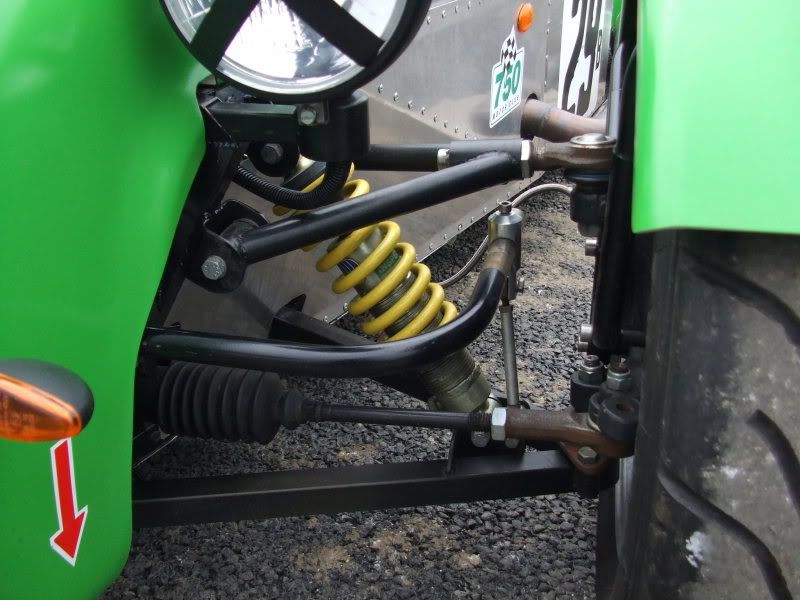
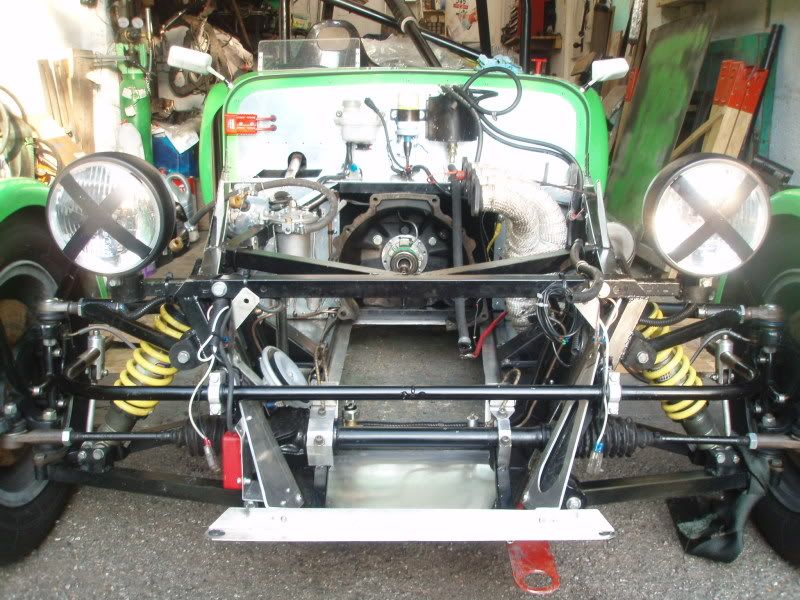
(please excuse it looking a little untidy, picture taken during one of the mid-season engine out/re-builds
 )
) [Edited on 19/12/08 by andylancaster3000]

Hi All,
Has anybody made a DIY anti roll bar for the front, if so advice, suggestions, pics etc. would be greatly appreciated.
Cheers,
Ross
for an anti roll bar I believe the steel has to be sprung steel standard bar will potentially just twist and ultimately snap. I think you can buy them which would be the best option then adapt your suspension and chasis to suit. I believe westfields caterhams use them
Look HERE. NS Dev has made his own.
Are you sure you need one ? you will be adding a noticeable amount of weight, for little benefit.
John
Mild steel is OK provided you don't put to much twist in the bar which would exceed the elastic limit.
Nearly all steels have quite similar values for Young's modulus that is they are equally stiff or "springy" what varies greatly is
the elastic limit ie how far you can deform, stretch, squeeze or twist the steel before its' shape is permanently deformed.
Mild steel has a lower elastic limit than heat treated medium carbon steels (spring steel) but provide the design dosen't twist the anti-roll bar
excessively mild steel works just fine.
I once knew a guy who made an arb for his Formula Ford from electrical conduit --- that is just a bit on the iffy side but he claimed it worked
fine.
[Edited on 19/12/08 by britishtrident]
We made one to suit a book chassis. I'll have to get back to you on the exact tube grade as it isn't mild steel. The shape of it isnt great
but we were constrained by the packaging of it. The addition in roll stiffness it gave was estimated and springs choice was made factoring this in.
You may also notice it was made in two pieces, this was due to not having one bit long enough!
(please excuse it looking a little untidy, picture taken during one of the mid-season engine out/re-builds )
[Edited on 19/12/08 by andylancaster3000]
Make sure you do the back as well as the front.
Seen from ARB's mess up the handling of a car.
Hi Andy,
Thanks for the pictures, same concept as the Fraser but there they use two 45 degree bends instead of one 90. I'll appreciate it if you can let
me know the material spec. Thanks.
Ross
On a front engined RWD car a front ARB is usually a good idea, buT a rear ARB on isn't always as a rear ARB can seriously rob the car of
traction.
The basic working model is stiffening the front of the car in roll (either by a stiffer anti-roll bar or stiffer springs) increases
understeer/reduces oversteer and can improve traction. Stiffening the rear in roll increases oversteer/reduces understeer BUT has an effect on
traction.
Really a gross simplification but it is the general way it works.
Thanks to all the guys who responded.
Ross
Anti roll bar material is typically EN45 or 4130 if I remember correctly. Available from specialist steel stockholders but why bother?
Find a suitable bar from an existing car and adapt it to suit. The ends can easily be made shorter as can the central portion of the bar by cutting/
shutting and sleeving. A caterham bar must be close dimensionally and they are available in a variety of thicknesses.
Although the various lengths of arms, centre portion etc. make a difference to the bars stiffness the over-riding factor is thickness of bar. The
stiffness increases as the fourth power of the thickness, so even a 1 or 2mm increase can make a tremendous difference. Can I suggest a 15mm or 16mm
bar to start with. No bigger unless its tube.
On our Phoenix we have used the central straight portion of a 16mm Caterham bar and made adjustable "blade" type arms from Titanium. These
could more easily be made from steel but I had some Titanium lying around...
Alternatively you could engineer in some form of sliding adjustable clamp arrangement like on the previous post. Make the mounting points rigid and
dont use rubber bushes. Use "poly" type bushes or none at all.
Useful link here..
http://www.lumenique.com/Cars/mcoupe/modifications/antirollbars.htm
The pics below show our bar before the mounts were made. The blades are almost certainly too thick but thats easily sorted.
Geoff.
[img] [/img]
[img] [/img]
thats a nice set up, can you tell me how you fitted the end of the blade to the end of the bar, is it just a machine fit and bolted in place?
Correct.
The end of the blade is threaded for the caphead and is a good "fit" in the cup on the end of the bar. There are no forces trying to rotate
the blade so the single caphead is sufficient. Having adjustment at both ends gives a massive range of adjustability. The ends don't have to be
at the same angle.
See link below for more pics of car. Might give you a few ideas??
Geoff
http://www.pistonheads.com/gassing/topic.asp?h=0&t=502785&nmt=CAR%20PORN%20%20ALERT%20!!!!!!%20Our%20%20trackday%20kit%20car.
[Edited on 19/12/08 by SPYDER]
quote:
Originally posted by SPYDER
There are no forces trying to rotate the blade so the single caphead is sufficient.
Hi Spyder,
Thanks for the pics and the suggestions. Caterham prts are like hen's teeth in South Africa and Birkin parts are just ridiculously expensive. I
thought about using a bar from a donor vehicle and I'll probably set aside a day to mooch around some breakers yards and see what I can find. BTW
that suspension set up of yours is awsome.
Cheers,
Ross
quote:
Originally posted by MikeRJ
quote:
Originally posted by SPYDER
There are no forces trying to rotate the blade so the single caphead is sufficient.
That's true with the blade set to maximum or minimum stiffness, but with intermediate angles I'm fairly sure the resulting deflection will cause some torque to be applied to the captive end of the blade.
I suspect it might err be a little on stiff side for light weight car.
Worth reading up on the problems Robin Hoods had using the standard Sierra front ARB.
what about using solid bar, stainless steel about 18mm? i have a 16mm tube bar with a 3-4mm wall thickness and i want more, i have some s/steel solid bar which i could easily bend to the same shape as my bar. I have some adjustment as the drop links can slide a little
quote:
Originally posted by SPYDER
I don't see how the rose joint at the far end can transmit anything but up/ down load to the end of the blade.
Every blade type arrangement I've seen has the same single bolt.
Geoff.
quote:
Originally posted by britishtrident
I suspect it might err be a little on stiff side for light weight car.
Worth reading up on the problems Robin Hoods had using the standard Sierra front ARB.
There can't be too much torque on the adjustable "blade" type ARB. The driver adjustable ones use bearings on the ARB, and a cable
that goes to a lever which locks. Meaning if there was a lot of force, the cable would get destroyed. I'm sure a cap screw would be fine but it
may end up loosening over time if it's torqued in the wrong direction.
Cheers.
Bit of a thread revival here, but...
Are arb's typically hollow, or solid?
quote:
Originally posted by scootz
Bit of a thread revival here, but...
Are arb's typically hollow, or solid?
And to actually answer your question.... 
Typically where material and manufacturing costs are an issue but weight isn't (ie road car) they will be solid. Where cost isn't an issue
and weight is (racing) they will be hollow. Mine is made from CDS.
[Edited on 12-5-12 by phelpsa]
I have a sierra front arb on my kit, will be taking if off and
Replacing it with tie bars when I get my head round how to do it!
quote:
Originally posted by scootz
Bit of a thread revival here, but...
Are arb's typically hollow, or solid?
quote:
Originally posted by theduck
I have a sierra front arb on my kit, will be taking if off and
Replacing it with tie bars when I get my head round how to do it!
Cheers.
It's for the VW-style beam that I'm fitting to the front of the trike. I've decided I'll be running coil overs on the top tube
and instead of having a torsion bar in the bottom tube, I'll delete it and just solidly connect the bottom trailing-arms via a 5/8" 4130
CrMo tube as the ARB.
Seeing as we are reviving an old thread. I have been toying with the idea of trying one of
these, should fit reasonably well,
being for the Sierra.
You can also buy the individual
parts.