
truth or bulls**T
mangogrooveworkshop - 3/11/04 at 05:49 PM
My cousin sent me this from Zimbabwe is it true or false I found the link http://www.esato.com/archive/t.php/t-70969
I had a picture that the email software has killed left on my desk at work. (Post that later)
New mini petrol engine
By JOHN SCOTT
SCIENTISTS have built the smallest petrol engine - tiny enough to power a WATCH.
The mini-motor, which runs for two years on a single squirt of lighter fuel, is set to revolutionise world technology.
It produces 700 times more energy than a conventional battery despite being less than a centimetre long - not even half an inch. It could be used to
operate laptops and mobile phones for months on end - doing away with the need for recharging.
Experts believe it could be phasing out batteries in such items within just six years.
The engine, minute enough to be balanced on a fingertip, has been produced by engineers at the University of Birmingham. Dr Kyle Jiang, lead
investigator from the Department of Mechanical Engineering, said: "We are looking at an industrial revolution happening in peoples'
pockets.
"The breakthrough is an enormous step forward. Devices which need re- charging or new batteries are a problem but in six years will be a thing of
the past."
Other applications for the engine could include medical and military uses, such as running heart pacemakers or mini reconnaissance robots. At present,
charging an ordinary battery to deliver one unit of energy involves putting 2,000 units into it.
The little engine, because energy is produced locally, is far more effective.
One of the main problems faced by engineers who have tried to produce micro motors in the past has been the levels of heat produced.
The engines got so hot they burned themselves out and could not be re-used. The Birmingham team overcame this by using heat-resistant materials such
as ceramic and silicon carbide.
Professor Graham Davies, head of the university's engineering school, said: "We've brought together all the engineering disciplines,
both materials, chemical engineering, civil engineering, and mechanical engineering.
"What better place to have the second industrial revolution - in nano-technology - than where the first took place, in the heart of the West
Midlands."
[Edited on 3-11-04 by mangogrooveworkshop]
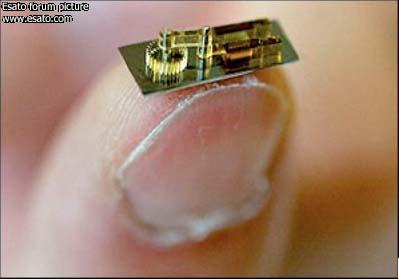
[Edited on 3-11-04 by mangogrooveworkshop]
mookaloid - 3/11/04 at 06:17 PM
Hasn't something been posted about this before?
If it's the same thing it just a bit of daft if you ask me
I love speed :-P - 3/11/04 at 06:37 PM
no afence but i wouldnt have an ic engine in my watch, what about the polluiton? what if there is no oxygen< ie swining or when u put ur hand under
a pillow? and what about that the fact where is it going 2 get its spark, how can u start it, o yea, what would stop something going wrong, and ur
watch just birts into flames
ayoungman - 3/11/04 at 06:54 PM
Do you remember when the tiny radio control toy cars came out ? Their electric motors are smaller than 8mm diameter and 10mm long. They must have been
developing them for some years. I'm suprised the Japanese didn't get there first.
JoelP - 3/11/04 at 07:02 PM
lies, damn lies...
JoelP - 3/11/04 at 07:04 PM
quote:
Originally posted by mangogrooveworkshop
The mini-motor, which runs for two years on a single squirt of lighter fuel...
dont tell me four of you lot actually believed this bit?!?!?! ROTF...
stephen_gusterson - 3/11/04 at 07:38 PM
it was posted a couple weeks back
the pic is a bit of plastic crap on a plate.
how can somethign run for ages on a single drop of ligher fuel.
if you think this is true, im taking advance orders for them at 100 quid a time
hurry hurry.
limited qty
very limited
like none
atb
steve
zilspeed - 3/11/04 at 07:45 PM
I'm running an uprated one on a throttle body and mapped ignition and injection via megasquirtjoltjuniorpiconanohyperultrablaster.
V1.01
MikeP - 3/11/04 at 08:04 PM
I've seen science stories of work in this area, IIRC they're talking about small fuel cells that run using refills of hydrocarbon fuels like
butane. You don't recharge or change the batteries anymore, you add another squirt of fuel or change a cartridge when you run low. Theory is
there's a higher energy density and less total polution with this type of fuel cell vs batteries, and it's more convenient.
Whether the engine itself is tiny or not is a separate idea. Nano engines can do some cool things, like running off of brownian motion and the like,
but they can only power nano machines. Lots and lots of them could potentially do some interesting things... but they're still trying to figure
out how to build lots of them economically (self assembly). Cool stuff though.
jollygreengiant - 3/11/04 at 10:33 PM
You could grow mushrooms on it, surely.
JoelP - 3/11/04 at 10:34 PM
i wouldnt dispute the potential of nanotechnology, its just that this particular device bends the laws of thermodynamics. as you say, fuel cells are a
different idea entirely.
indykid - 3/11/04 at 11:33 PM
what a load of old tosh!
a great big tut goes out to those five, yes five believers. I'd put it squarely next to the three wheel top fuel dragster.
good god, what's the world coming to?

tom
sgraber - 4/11/04 at 12:34 AM
Well the above item is surely fake, but a quick search for 'micro engine' on Google brought up a bunch of really interesting links. Here are
two good ones!
http://www.technologyreview.com/articles/04/11/freedman1104.asp?p=1
and this one
http://www.darpa.mil/mto/mpg/summaries/2003_1/index.html
That should get the imagination flowing!
Graber
Hellfire - 4/11/04 at 01:06 AM
As a ceramic engineer - this is total tosh!
Ceramics this small would have such a small effect on heat resistance it would be negligeable. Any ceramic be it almost pure Aluminium Oxide, silica
aluminium oxide or permutations of any of the other forms (top secret!) when hot become very brittle and unstable.
[Edited on 4-11-04 by Hellfire]
ned - 4/11/04 at 09:50 AM
I'm sure I read about this in the paper....
Ned.
Fifer - 4/11/04 at 04:21 PM
I think it's true, it's just that the guy has got massive fingers and the picture is of a 50cc motor

Simon - 4/11/04 at 10:23 PM
How about this (especially useful if building a scale locost based on a Mazda rotary)
http://www.coe.berkeley.edu/labnotes/0701worldssmallest.html
ATB
Simon
mangogrooveworkshop - 4/11/04 at 10:38 PM

Wow what a good discussion. It had me for a minute but doing some research cold water was cast on this "hot" idea.
Peteff - 5/11/04 at 12:24 AM
It's in a chainsaw I use to trim my bonsai garden.
marktigere1 - 5/11/04 at 02:15 PM
Does this mean that your watch of the future will need an emmisions test?
And a service every 12000 miles!!!
Cheers
Mark
MikeP - 5/11/04 at 03:32 PM
funny guys
Birmingham U seems to think it's real:
http://www.publications.bham.ac.uk/birmingham_magazine/bmag2003/adventures.htm
This story says it is a tiny wankel engine, I've never heard of internal combustion engines this size. Seems like fuel metering would be really
tough too, right?
flak monkey - 7/2/06 at 11:38 AM
Sorry to drag this up again, but... actually...
http://www.micro-nano.bham.ac.uk/
http://www.micro-nano.bham.ac.uk/micro.htm
I wonder what that pic is of on the right of the screen
http://www.eng.bham.ac.uk/mechanical/images/microengine1.jpg
David
smart51 - 7/2/06 at 11:53 AM
liquid fuel has a much higher energy density than a battery. Batteries are truely terrible. If I'd read that it was a tiny fuel cell running on
something like hydrogen, methanol or methane then I'd believe it. No moving parts. tiny membrane, electrical circuit. Easy 10mm device for
microwatt power.
IC engine? Nano technology will eventually get things this small but I am a little sceptical. Fuel cells are highly efficient as they don't
use a thermal process. IC engines are, what, 10 or 20% efficient? Even a tiny engine has got to get quite warm.
cossey - 7/2/06 at 02:10 PM
ic engines are 20-50ish % efficient with bigger and slower moving normally equalling more efficient. with normal car engines being around 26-27%.
as for whether its real or not id say it probably is. car engines put out many 1000s of watts whereas this would be putting out around a few
milliwatts so it would last for a very long time on very little fuel. if you look at watches there a loads that work just on the energy gained from
shaking them whilst wearing them.
steve_gus - 7/2/06 at 08:47 PM
http://www.eng.bham.ac.uk/people/davies.htm
the professor quoted has his email on that page.
why not just ask him if its bolllox or not?
atb
steve