Ive been reading about compound turbo charging but cant find any math on the subject to help me understand
my basic knowledge of it so far is you run a small turbo from the exhaust as normal, this then spools a larger turbo to the intake manifold thus
giving more boost quicker. it was developed in WW2 by the looks and development stopped because they where producing too much power and jet engines
became easier.
it seems they do it on big power conversions in the US (think 1200bhp+) but i cant find any mention of here in the UK, is this because its called
something else here, or just because we dont do it? It also appears to be a bit of a 'dark art', there must be information to help the
noob
basically i was looking for some calculations to work out the matching of the turbos to see what was possible, the benefits seem to be immense but i
might be misunderstanding.
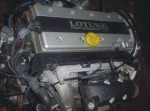
heres a sexy picture i found
I dont have an application for it (yet), just interested
Photo Archive
Building: Book (Ron's) 1300 X-flow Locost 7
posted on 4/10/11 at 01:02 PM
I realise it may be just my eyes - age you know - but in that photo the primary turbo seems largere than the secondary turbo, opposite to your
descrition.
its definatley smaller to larger (from what ive read)
that pic just turned up on google with me doing a search for compound turbo, it might well not be
it seems a really easy way to make big power, providing the turbos can be matched, i imagine heat to be a problem and Im not sure I understand
pressure and boost when it enters the cylinder from the manifold. as in can i put too much air in?
Basically it is the turbo equivalent of a two stage supercharger, compressing in two stages has big advantages especially if you can cool the charge
between stages.
Is this not "sequential" turbocharging? "Compound" usualy refers to a turbo that recovers mechanical energy which is
directly added to the engines output (rather than just used to compress air so even more fuel can be burnt).
I can't see how this would work without some kind of valve to direct the exhaust gas flow between the small and large turbos?
Hmm, I was thinking more of a twin turbo thing where you'd have a smaller turbo that spools up quickly, and a larger turbo for the real power.
The smaller one is kind of used to prevent turbo lag (well, reduce it) in massive chargers
compound turbocharging is different to a turbo-compound engine though the two sound very similar, turbo-compound engines are like you say driven from
the crank
on a sequential system, I dont believe that the smaller turbo feeds the larger turbo, they are just ran at different times, one then the other, small
for low rpm and then big for high rpm - the RX7 had a sequential twin turbo
quote:
Sequential turbos refer to a set-up in which the motor utilizes one turbocharger for lower engine speeds, and a second or both turbochargers at higher
engine speeds. Typically, larger high-flow turbochargers are not as efficient at low RPMs, resulting in lower intake manifold pressures under these
conditions. On the other hand, smaller turbos spool up quickly at low RPMs but cannot supply enough air at higher RPMs. During low to mid engine
speeds, when available spent exhaust energy is minimal, only one relatively small turbocharger (called the primary turbocharger) is active. During
this period, all of the engine's exhaust energy is directed to the primary turbocharger only, providing the small turbo's benefits of a
lower boost threshold, minimal turbo lag, and increased power output at low engine speeds. As RPM increases, the secondary turbocharger is partially
activated in order to pre-spool prior to its full utilization. Once a preset engine speed or boost pressure is attained, valves controlling compressor
and turbine flow through the secondary turbocharger are opened completely. (The primary turbocharger is deactivated at this point in some
applications.) In this way a full twin-turbocharger setup provides the benefits associated with a large turbo, including maximum power output, without
the disadvantage of increased turbo lag.
Yes, it's a different thing to what you se on cars to get around the lag from a big turbo by using a small one along side it to boost from low
revs. With compound turbos one blows into the next, all the gases flow through all the turbos one after the other.
As mentioned it's used in tractor pulling where they're looking for power levels on a big scale, an engine that left the factory with
100-140bhp will see boost levels like 200psi & make over 1000bhp. You dont get anything for nothing though & engine blow-ups happen in a
literal sense, like the block will split between the crank webs & base of the bores!
Don't know if there's much advantage over conventional turbo set-ups in it for making the levels of boost you'd want on an engine
that you want to be reliable.
Heat and weight are your biggest enemies. Then there's the space needed.
Turbo into a super is common on heavy equipment. But they usually divert the turbo straight into the engine at a set boost pressure.
Where's BT? His big ships have some beautiful turbo/super systems.
I went past a place in Totton the other day, where they rebuild this ship stuff. They had a turbo sitting outside, must have been 4' across! And
that's a little one!
We used to install Volvo KAD44 engines into our motor yachts which were Supercharged and Turbocharged The Roots type superchargers were geared up and
crankshaft driven through electric clutches which disengaged at 1900 rpm. There was a flap valve which allowed which ever induction path ran at the
higher pressure to feed the air to the intercooler.
This set-up worked really well at delivering seamless boost throughout the rev range. I have never seen this used in a car, Why not?
quote:Originally posted by plentywahalla
We used to install Volvo KAD44 engines into our motor yachts which were Supercharged and Turbocharged The Roots type superchargers were geared up and
crankshaft driven through electric clutches which disengaged at 1900 rpm. There was a flap valve which allowed which ever induction path ran at the
higher pressure to feed the air to the intercooler.
This set-up worked really well at delivering seamless boost throughout the rev range. I have never seen this used in a car, Why not?