Slimy38
|
| posted on 24/3/26 at 08:39 AM |

|
|
Brake efforts from IVA
For those that have gone through IVA, does anyone know what their brake efforts were? I need to improve my brake efforts but I'm not sure what I
have available.
For reference, mine were as follows;
Axle 1 134 194
Axle 2 91 96
That gives me a total of 515kg braking effort. For my new design weights I need to find 570kg of effort, but I am wondering whether that sort of
effort is possible. If I could just get axle 1 NS up to the same as OS that would suffice, I'm not sure how to do that though.
My braking system is basically stock MX5 NA, with the brake booster deleted.
I have found one post about braking results from Skov's test fail, the numbers are very similar but I can't find any info on what he did to
resolve it, and he's not been on here for the last 8 years (I think he sold his car a long time ago).
|
|
|
|
|
JAG
|
| posted on 24/3/26 at 12:00 PM |
|
|
I did my SVA back in 2005, so I forget how the brake test works.
What do the numbers represent? Are those numbers when the wheel locks?
IF it's when the wheels lock then the only thing you can do is fit stickier or better tyres.
IF it's at a particular brake pedal effort then you can change the pedal ratio or the master cylinder bore size.
Justin
Who is this super hero? Sarge? ...No.
Rosemary, the telephone operator? ...No.
Penry, the mild-mannered janitor? ...Could be!
|
|
|
JAG
|
| posted on 24/3/26 at 12:39 PM |
|
|
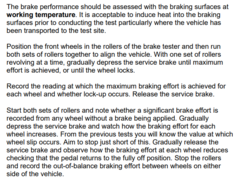 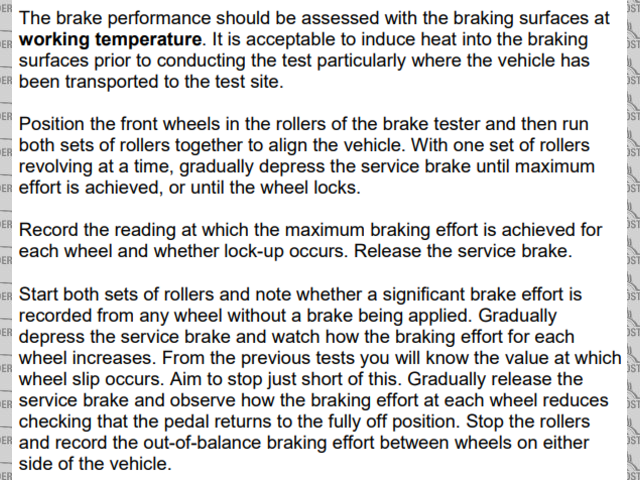
IVA Manual Brake Test
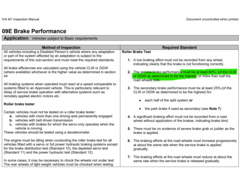 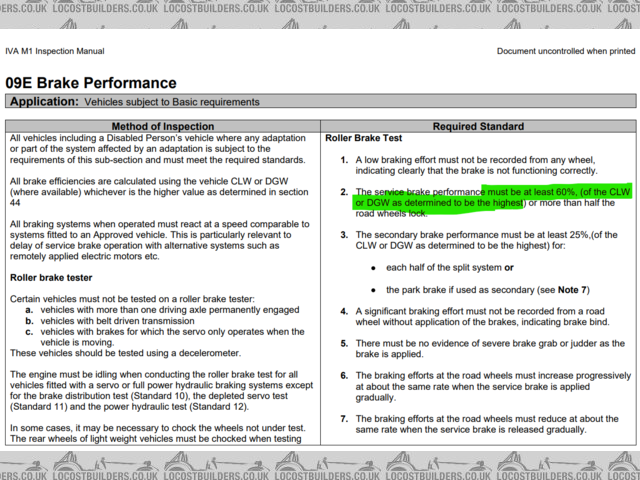
Brake Test
So it looks like the Tester will depress the brake pedal until brake force hits a maximum, and stops increasing while the wheel rotates OR until the
wheel locks. Wheel lock is much more likely!
But the interesting bit is that they compare the forces to a minimum target of 60% of the cars weight: CLW or DGW whichever is the highest.
Now I don't know what those weights are but if you're about to change weights then it would be worth making sure the brake numbers you
already have are 60% of the new weight  
[Edited on 24/3/26 by JAG]
Justin
Who is this super hero? Sarge? ...No.
Rosemary, the telephone operator? ...No.
Penry, the mild-mannered janitor? ...Could be!
|
|
|
Slimy38
|
| posted on 24/3/26 at 02:49 PM |
|
|
Stickier tyres did cross my mind, the numbers on the front are when the wheels slid on the rollers. It was a wet day which probably didn't help,
but I suspect the amount of water actually on the tyres didn't make a huge difference. The tyres were also overinflated to help with self
centering, now they're back to normal pressures I think maybe there's a bit more cross section actually touching the rollers?
I had to change my weights because my design weight was lower than the calculated. I've gone for recommended numbers but they put me over the
limit for braking effort.
|
|
|
gremlin1234
|
| posted on 24/3/26 at 03:34 PM |
|
|
the old way of getting better braking after a car has been off the road; was always to drive it hard, and brake hard, (itallian tune up but for the
brakes)
I also remember taking my underused tin-top for an mot and noticing the brakes were better after the test, as they had applied them much harder than
I ever do.
|
|
|